"The beginning of a new scientific paradigm": Zuckerberg's Biohub, U.S. and Google build virtual cell
Mark Zuckerberg's Biohub is partnering with Google and the federal government in its ambitious effort to use AI for generating vast quantities of biological data that can predict how cells behave. Why it matters: The ultimate goal is an AI model that lets scientists test potential experiments virtually, helping them identify the most promising ones before spending the time and money to perform…
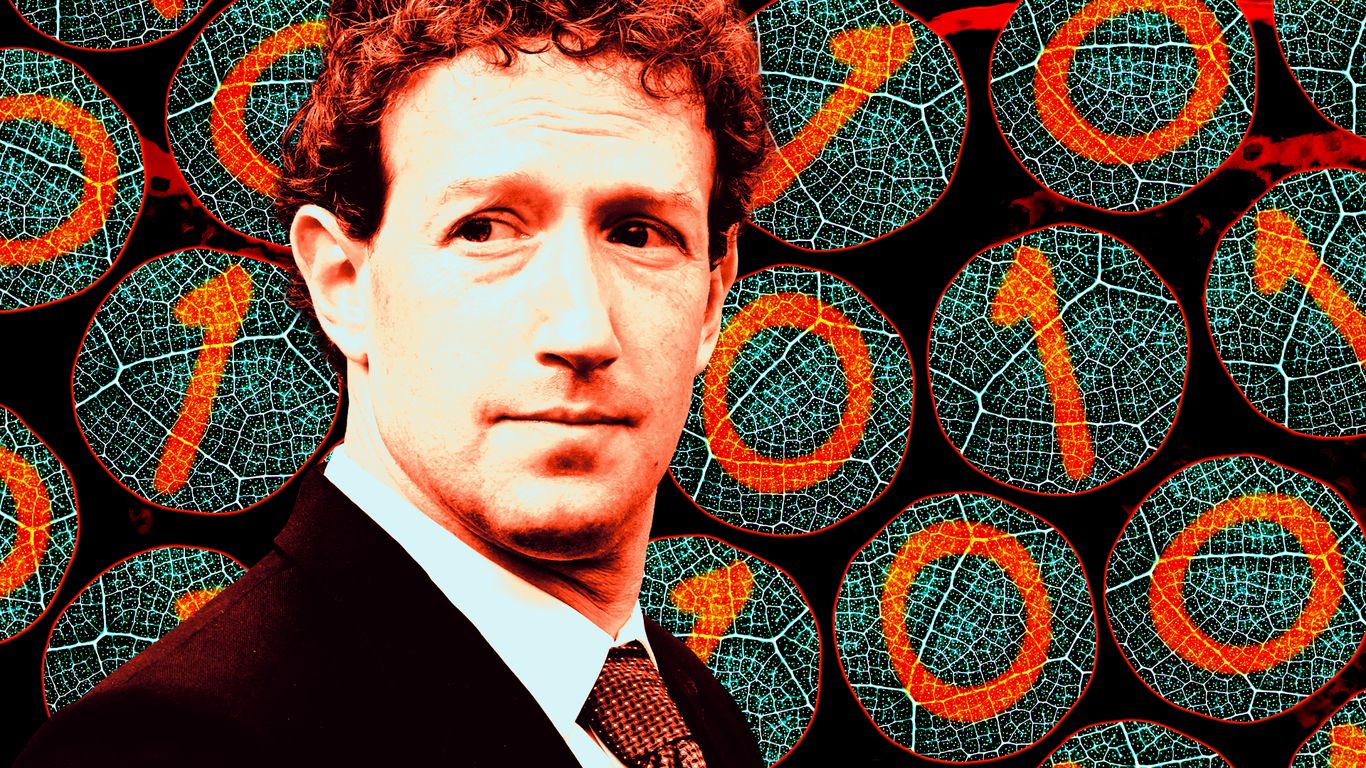
Mark Zuckerberg's Biohub is joining forces with Google and the U.S. government in a groundbreaking initiative to harness AI for generating vast amounts of biological data. This data aims to predict how cells behave, with the ultimate goal of developing an AI model that allows scientists to test potential experiments virtually. This approach would save time and resources by identifying the most promising experiments before conducting them in the lab.
The collaboration involves Biohub, the Department of Energy, the National Institutes of Health, Google DeepMind, Isomorphic Labs, Meta, and various scientific organizations.
The primary challenge lies in the sheer complexity of modeling an entire living cell, which is orders of magnitude more intricate than modeling proteins and other biological components. Researchers currently lack sufficient data to tackle this challenge. However, with the advent of AI, the scientific landscape is poised for a paradigm shift.
Alex Rives, head of science at Biohub, highlighted the transformative potential of this collaboration, stating, "If we can put more and more reasoning and intelligence into every single question we ask in the lab, the value of those empirical results will be far greater."
Much of AI's recent progress stems from combining better algorithms, increased computing power, and massive data sets. However, biology presents a unique challenge due to the absence of extensive data, which must be painstakingly measured from the physical world. Rives emphasized the need for "empirical AI" models that can learn from biological evidence and accurately predict outcomes in the real world. The key to bridging this gap lies in data acquisition.
The initial phase of the project will involve creating a comprehensive map of cellular biology by gathering diverse information about cells and their responses to changes. In the long term, the models could potentially investigate fundamental questions such as aging, regeneration, and medical issues like the molecular mechanisms behind Alzheimer's disease.
Currently, commercial partners will have exclusive access to the developed data for a year before its public release. This temporary advantage is intended to incentivize companies to contribute financially, ensuring the data becomes an open scientific resource.
The collaboration is backed by $1.8 billion in funding, data, computing resources, and measurement technology. The Department of Energy plans to invest over $500 million in five years for biological measurement, modeling, and computing, while the National Institutes of Health will contribute datasets and resources from more than $500 million in previous federal investments.
Google DeepMind, Isomorphic Labs, and Meta are investing an additional $300 million collectively, while Biohub has committed $500 million to the endeavor.
Written by urgent.news from Axios's reporting — not their text. Machine-written — may contain errors; check the original before relying on it.