Like a Mythical Phoenix, This Planet May Have Risen From the Ashes of a Dead Star
The “second-generation” world, predicted from telescope data, could be the first known planet of its kind, and it may shed light on the future of our own solar system
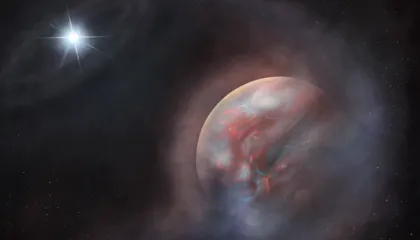
Astronomers have made a startling discovery of a never-before-seen type of planet, dubbed a "phoenix planet," emerging from the remnants of a dying star. This unexpected finding suggests that more such reborn worlds may exist throughout the universe and could provide insight into the eventual fate of our own solar system.
The unnamed exoplanet orbits a white dwarf, called HS 0209+0832, located about 270 light-years away from Earth. White dwarfs are the remnants of massive stars that have exhausted their fuel and collapsed into shrunken remnants, often referred to as "zombie stars." This particular white dwarf is relatively young, still burning at around 63,000 degrees Fahrenheit (35,000 degrees Celsius), indicating it has undergone this transformation within the past few million years.
Scientists were previously uncertain about the presence of heavy elements, such as aluminum, titanium, and nickel, in the white dwarf's visible spectrum. These elements, which are not typically found within white dwarfs, hinted that something unusual was occurring. However, the details remained unclear until recently.
In a study published in Nature Astronomy, researchers employed Hubble's updated instruments and data from other observatories to examine HS 0209+0832 more closely. Their observations revealed a high concentration of additional heavy elements, including zinc, copper, and niobium, which have never been detected in a white dwarf before. These elements are believed to have formed during the red giant's demise and later coalesced into a second-generation planet around the newly formed white dwarf.
The researchers hypothesize that the planet's atmosphere is being eroded by the white dwarf's stellar winds, causing the rare elements to fall back onto the zombie star. By analyzing the orbit and transits of the exoplanet, the team estimated that the planet is roughly the size of Jupiter, with a highly elliptical orbit lasting around 4.4 Earth days. This close proximity to the white dwarf also supports the idea that the planet's atmosphere is being stripped away.
While other exoplanets have been found orbiting white dwarfs, this is the first time a "second-generation" planet has been identified, formed from the material ejected by its dying star. The unique element composition of the planet around HS 0209+0832, indicative of the s-process—a nuclear reaction that occurs during a star's bloated red giant phase—provides strong evidence that this planet is a phoenix reborn from the ashes of its parent star.
Written by urgent.news from Live Science's reporting — not their text. Machine-written — may contain errors; check the original before relying on it.
This story
This is one outlet's version. Read the fullest account.