IceCube, high-energy neutrinos, and Francis Halzen win 2026’s Physics Nobel
There’s a whole entire Universe out there, and the more we learn about it as it actually is, the greater our potential becomes to achieve great things as a civilization, even if the path from knowledge to improving humanity is far from clear. The Nobel Prize was set up more than 100 years ago with the express purpose of rewarding those whose work provides the “greatest benefit to humankind” in a…
In 1987, a remarkable event captured the attention of scientists worldwide - a supernova in the Large Magellanic Cloud, the closest observed supernova to Earth in over three centuries. The burst of energy and neutrinos released by this supernova was detected by various experiments on Earth, marking a significant milestone in neutrino astronomy. Out of all the detectors, the Kamiokande experiment in Japan recorded the highest number of neutrinos - 12, in a span of just 13 seconds.
The success of this detection led to the birth of a new field: neutrino astrophysics. The underlying idea was that neutrinos emitted from distant astrophysical events could potentially be detected on Earth, providing insights into these events and phenomena. The challenge, however, was that neutrinos interact so rarely with matter that detecting them required a massive detector volume.
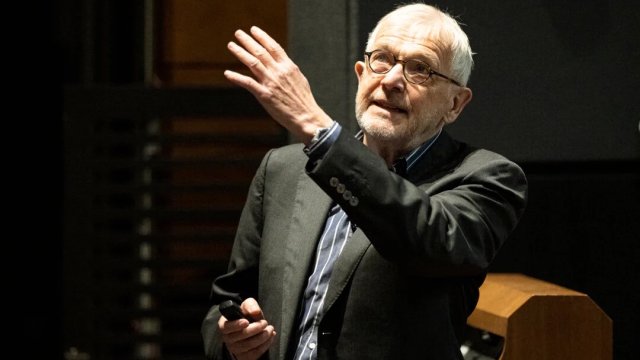
It was Francis Halzen who, in 1988, proposed a novel approach to neutrino detection. Instead of using a large tank of liquid surrounded by photomultiplier tubes (as used in experiments like Kamiokande), Halzen suggested constructing a massive array of detectors spread across a large volume of ice. This approach, called IceCube, would allow for the detection of neutrinos by observing the Cherenkov radiation emitted when these particles interact with the ice.
The IceCube Neutrino Observatory was built in Antarctica, taking advantage of the density and clarity of the ice to create an unprecedented observing platform. The project was a testament to Halzen's creativity, hard work, and persistence, as well as the strong national investment in scientific research. It was this vision and execution that ultimately led to Halzen being awarded the 2026 Nobel Prize in Physics, alongside his colleagues, for "decisive contributions to the IceCube Neutrino Observatory and the discovery of high-energy neutrinos of astrophysical origin."
Rewritten by urgent.news; may contain errors — check the original.