Hybrid Digital Twins Developed for Future Autonomous Labs
An academic laboratory is developing a hybrid digital twin that integrates a mechanistic model with artificial intelligence, with the long-term goal of driving the future of next-generation autonomous robotic laboratories. The post Hybrid Digital Twins Developed for Future Autonomous Labs appeared first on GEN - Genetic Engineering and Biotechnology News .
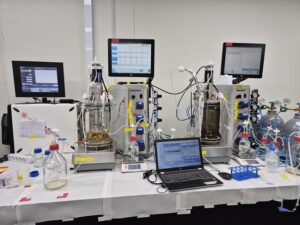
South Korean researchers are creating a hybrid digital twin that integrates mechanistic modeling with artificial intelligence, in pursuit of an autonomous laboratory. Dong-Yup Lee, a professor at Sungkyunkwan University, explains that the team has been merging a mechanistic model with a data-driven AI model to form a hybridized system.
This digital twin is distinct from conventional simulators as it is constantly linked to a multi-sensory modeling system that gathers data from their lab's bioreactor. The scientists employ mathematical models of Chinese Hamster Ovary (CHO) cells to forecast how they will react under varying bioreactor conditions. However, Lee notes that predictions solely based on the mechanistic model may lack the precision and adaptability needed for real-time operations.
To enhance adaptability, they have incorporated data-driven AI as a supplement. While AI excels at making predictions with ample data, it struggles to provide explanations for those predictions. To address this, Lee's team utilizes Explainable AI (XAI), which sheds light on which input conditions have the most significant impact on process outputs.
This added interpretability can guide improvements and controls over bioprocess performance. Lee states that the most significant hurdle they have encountered so far is integrating the mechanistic model with XAI, ensuring seamless connectivity between data collection, prediction, and forecasting with process control. Currently, the team is 80% complete with the hybridized model, with the final 20% dedicated to establishing linkages and interactions with the control system and future robotics.
This integration, Lee explains, will be the primary focus of their future research, aiming to move beyond predictive digital twins towards increasingly autonomous process operation. Lee is open to collaborations with industry partners, particularly those focused on digital twins, advanced bioprocess monitoring, and autonomous biomanufacturing.
Written by urgent.news from GEN Biotechnology's reporting — not their text. Machine-written — may contain errors; check the original before relying on it.