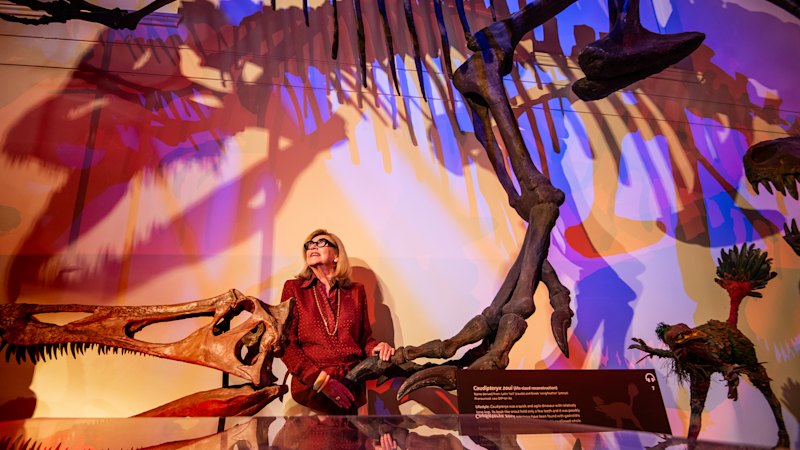
‘Bigger than anything I’ve seen’: Australian Museum to host the largest dinosaur to walk the Earth
Only a few Sydney institutions have reached the 200-year milestone. Next year the Australian Museum joins them – and the party begins with a huge exhibition.
A 1,000-mile-long Martian cloud, known as the Arsia Mons Elongated Cloud (AMEC), emerges and vanishes from the Red Planet's sky nearly every day, exhibiting exotic physics never observed on Earth. The cloud, spotted in 2018 by the European Space Agency's Mars Express orbiter, forms above Arsia Mons, a 12-mile-tall extinct volcano in Mars' Tharsis region.
The cloud lasts only a few hours before evaporating, stretching up to 1,100 miles long, roughly twice the length of the UK or the distance between New York City and Miami. While Mars is known for dust clouds and carbon dioxide streaks, it has almost no atmospheric water vapor, making the formation of Earth-like clouds, let alone one so large, extremely rare.
Using Mars Express data, researchers created simulations to explain the AMEC, discovering that homogeneous nucleation, a process where water vapor directly turns into icy cloud particles without forming ice crystals, is required. This phenomenon, which has never been seen before in a planetary atmosphere, is considered wholly unexpected and could only occur under extreme humidity levels, which the Mars Express data suggests are possible due to powerful wind waves created by the 12-mile-high Arsia Mons volcano.
Written by urgent.news from Live Science's reporting — not their text. Machine-written — may contain errors; check the original before relying on it.
This story
This is one outlet's version. Read the fullest account.