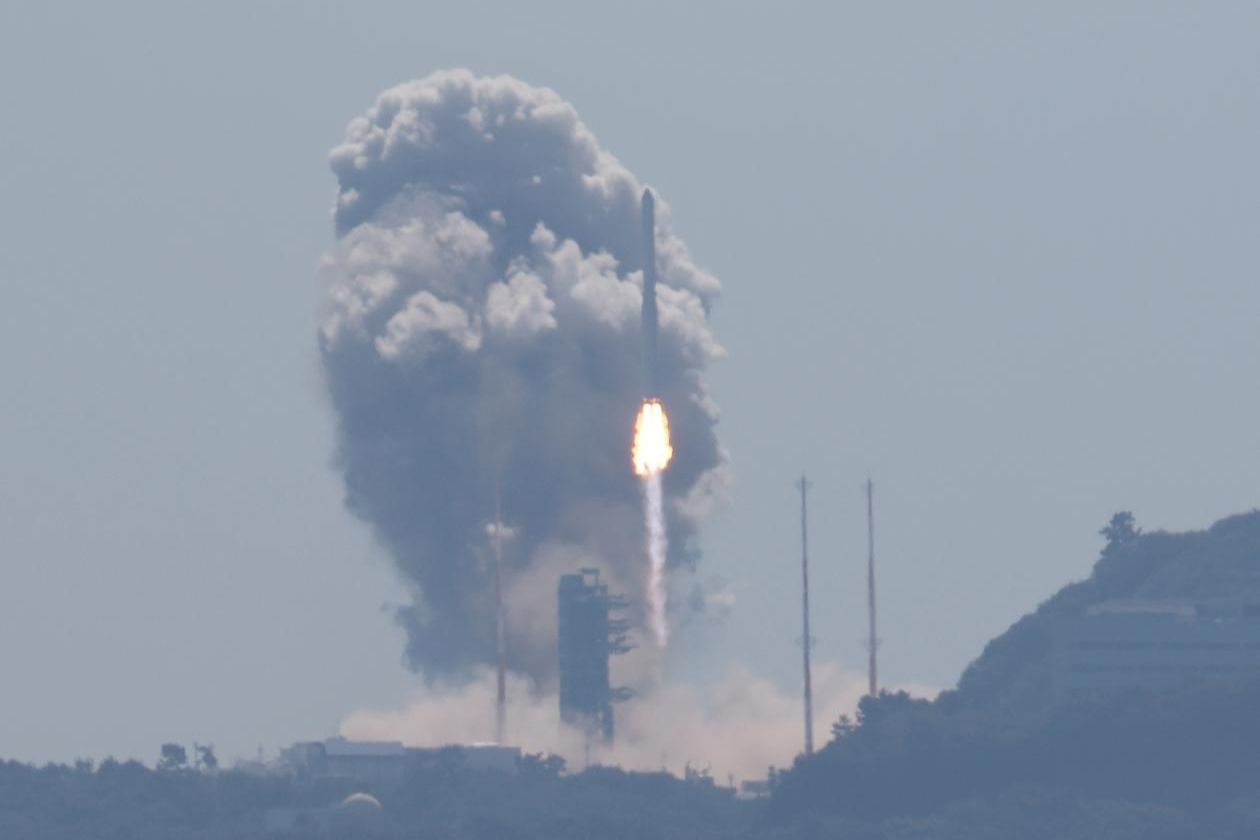
(3rd LD) S. Korea's Nuri space rocket lifts off from Naro Space Center
GOHEUNG, South Korea, Oct. 7 (Yonhap) -- South Korea launched its homegrown Nuri...
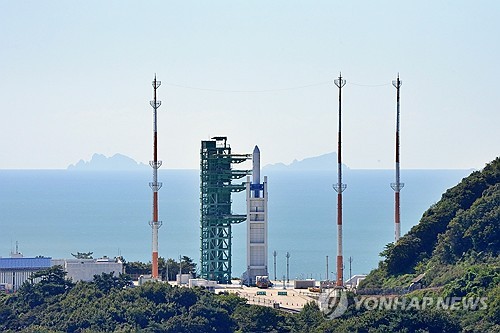
June 4, 1993 marked the launch of South Korea's first homegrown one-stage solid propelled science observation rocket, the Korea Space Rocket-I, after three years of development. In 1997, they followed up with the two-stage solid propelled KSR-II rocket, incorporating advanced technologies such as guided control and stage separation.
In 2001, South Korea joined the Missile Technology Control Regime, a global association overseeing the proliferation of unmanned delivery systems capable of delivering weapons of mass destruction. Plans for the Korea Space Launch Vehicle-I (KSLV-I) were confirmed in August 2002, with a launch initially set for 2005, but postponed to October 2007.
The Naro Space Center opened in June 2009, and after several delays, the KSLV-I's new launch date of August 19, 2009 was set. However, the rocket failed to deploy its scientific satellite when it was halted less than eight minutes before blastoff due to issues detected in a high-pressure tank.
Following another failure in 2009, South Korea began developing the KSLV-II rocket in March 2010. The first successful launch of the KSLV-I took place in March 2013, followed by the first combustion test of the 7-ton-class liquid engine combustor in March 2014. In March 2018, South Korea initiated comprehensive combustion tests for the KSLV-II rocket, and the rocket was officially renamed Nuri.
The first Nuri launch on October 21, 2021 faced a partial success, with the rocket failing to put a dummy satellite into orbit due to a helium tank malfunction. Despite this setback, South Korea successfully launched Nuri on June 21, 2022, deploying a dummy and performance verification satellites at a target altitude of 700 kilometers. This achievement marked South Korea as the seventh country to develop a space launch vehicle capable of carrying more than a 1-ton satellite.
Written by urgent.news from Yonhap News's reporting — not their text. Machine-written — may contain errors; check the original before relying on it.
This story
This is one outlet's version. Read the fullest account.
- Chronology of major events leading to S. Korea's 5th Nuri space rocket launch en.yna.co.kr
- Nuri rocket successfully deploys 15 satellites koreatimes.co.kr