Verkehr: Umwelthilfe: In vielen großen Städten rollen Verbrennerbusse
In vielen Großstädten fahren weiterhin überwiegend Busse mit Dieselmotor. Das hat die Deutsche Umwelthilfe herausgefunden. Es gibt aber auch Kommunen, die auf batteriebetriebene Elektrobusse setzen.
In many major German cities, diesel-powered buses continue to dominate the cityscape. According to an investigation by the German Environmental Aid (DUH), 70% of the 39 largest cities are made up of pure diesel buses, as revealed by a study provided to the German Press Agency in Berlin. When counting so-called mild-hybrids that use an electric motor to support the diesel engine, particularly during starts and overtakes, this percentage rises to 77%.
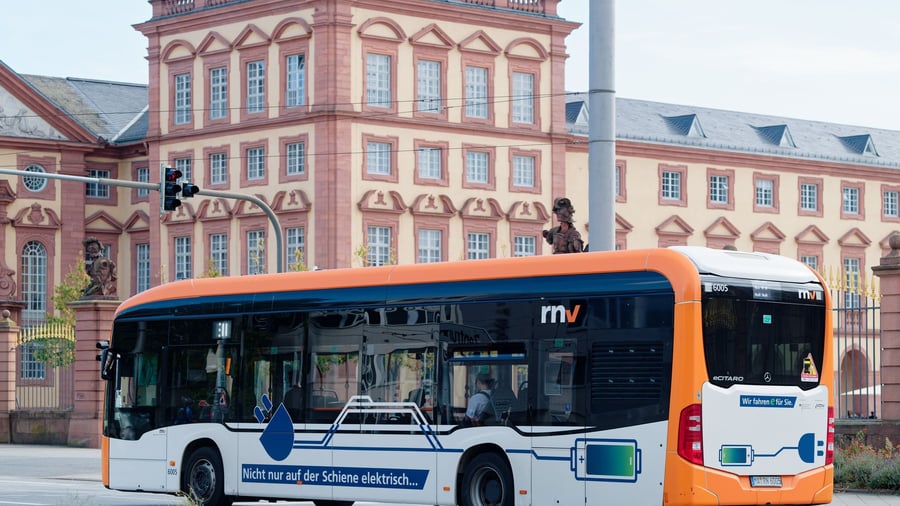
Mannheim leads the way The study also shows that some major cities are already far along in the transition to climate-friendly electric buses. Three cities in Baden-Württemberg are highlighted as top performers: Mannheim, where battery-electric buses made up 60.6% of the city's fleet at the start of the year, followed by Freiburg (51.7%) and Karlsruhe (51.6%).
All three cities aim to put only electric buses on the roads by 2030, if new acquisitions are planned. Electric buses create significantly fewer greenhouse gases than diesel buses, according to a 2023 study by the non-profit International Council on Clean Transportation. While production of electric vehicles generates higher emissions compared to diesel buses, these emissions are more than offset over the vehicle's lifetime due to their lower operating emissions.
The impact of electricity source, such as wind and solar, on the overall balance improves the electric bus's environmental record. Magdeburg, Krefeld, Wuppertal, Essen, and Augsburg lead the list of cities without any battery-electric buses. However, this doesn't mean that only diesel-powered vehicles are used, as in the case of Wuppertal, which has battery-electric buses with fuel cell technology.
These hydrogen fuel cell buses make up one-sixth of the fleet, according to the city's utilities. However, fuel cell buses are not widely used: they account for only 1.5% of the vehicles in the investigated 39 largest cities, according to the DUH. DUH criticizes the purchase of new diesel buses The DUH also values negatively the plan to purchase new diesel buses up to 2030.
Augsburg, where 30 new biogas buses were bought to replace outdated vehicles, ranks last as the city's utilities plan to buy 30 more biogas buses. The reason is that the transition to electric buses depends on the construction of the necessary infrastructure, which is not happening quickly enough. In Chemnitz, which was also surveyed among the 40 largest German cities, the DUH did not receive a response.
Diesel buses are typically operated for more than ten years in urban transport, according to DUH CEO Jürgen Resch. Therefore, cities purchasing new diesel buses delay the departure from fossil fuels until the 2040s. Resch urged municipal transit companies to stop buying new diesel buses and switch to electric propulsion by 2030.
Technically suitable diesel buses can be retrofitted to electric propulsion in the meantime. The organization criticizes that the federal government wants to cut back on funding programs for the purchase of buses with alternative propulsion.
Written by urgent.news from Handelsblatt's reporting — not their text. Machine-written — may contain errors; check the original before relying on it.