Solar system’s most bizarre moons! Take the tour
The solar system’s most bizarre moons reveal active, complex worlds that continue to surprise scientists. Are any of them harboring life? The post Solar system’s most bizarre moons! Take the tour first appeared on EarthSky .
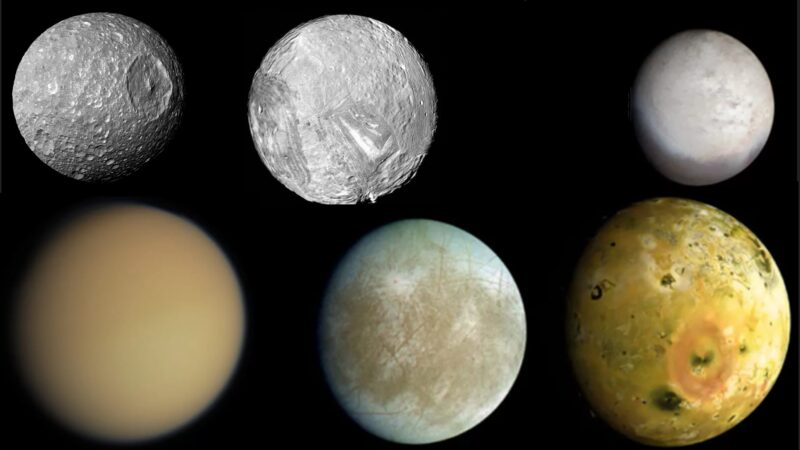
In our solar system, moons exhibit a remarkable diversity of characteristics. Beyond the familiar Moon, several moons stand out for their unusual features. Here, we embark on a tour of some of the strangest moons in our solar system.
First, Io, Jupiter's closest moon, is the most volcanically active world known. Its surface is in constant flux due to tidal heating caused by Jupiter's immense gravitational forces. This heating melts rock into magma, leading to eruptions that eject plumes hundreds of miles into space. The result is a surface covered in lava lakes and sulfur deposits, with no visible impact craters as eruptions continuously reshape the landscape.
Next, Europa, another of Jupiter's moons, hides a vast ocean beneath its icy exterior. This global ocean of liquid water may contain more water than all of Earth's oceans combined. Repeated cracks on the surface suggest that this ocean shifts beneath the ice, and scientists believe it could harbor conditions suitable for life.
Enceladus, a moon of Saturn, captured everyone's attention when NASA's Cassini mission discovered water vapor geysers erupting from its south pole. These geysers originate from an underground ocean, which, despite Enceladus' weak gravity, shoots material into space. This material feeds Saturn's E ring and contains complex organic molecules that could be the building blocks of life.
Titan, Saturn's largest moon, boasts a thick atmosphere, making it the only moon in our solar system with weather, rivers, and lakes. However, these lakes aren't filled with water but with liquid methane and ethane. Titan's atmosphere shows signs of weather patterns, including clouds and rain. Recent missions, like NASA's Dragonfly, aim to explore this intriguing world further.
Finally, Mimas, Saturn's seventh-largest moon, resembles the Death Star from the Star Wars movies. Its surface features a large crater, named after the moon's discoverer, that covers a significant portion of its northern hemisphere. The crater's size and impact history make Mimas look eerily similar to the iconic space station from the famous film franchise.
Written by urgent.news from EarthSky's reporting — not their text. Machine-written — may contain errors; check the original before relying on it.