Reconciling AI Expected Revenues to CapEx
Jared Bernstein, along with others, calculates the revenues needed to rationalize the AI capital investment in place and planned. Source: Callum Williams via J. Bernstein. As Bernstein recounts, this amount of revenue is unlikely to occur within a time frame financial markets are likely to tolerate (i.e., soon). A BPEA paper by Stijn Van Nieuwerburgh […]
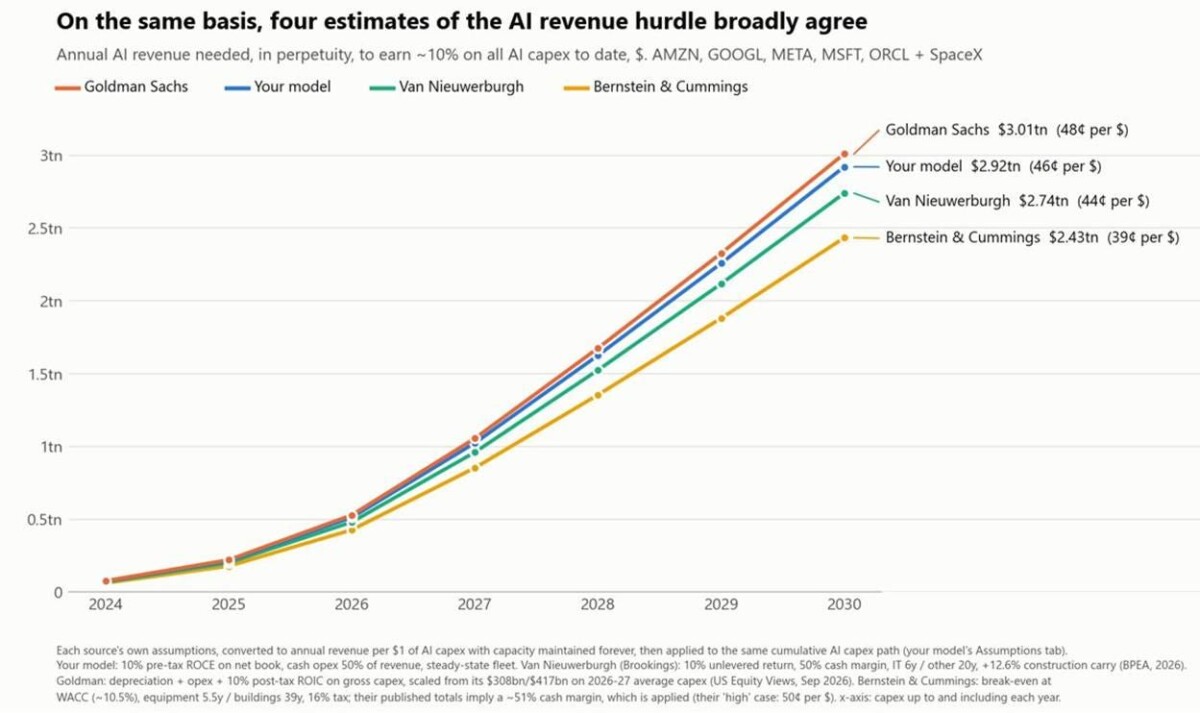
Jared Bernstein, alongside others, is determining the revenue necessary to justify the capital investment currently existing and being planned for AI. According to Callum Williams, quoted by Bernstein, this revenue is unlikely to materialize within a timeframe that financial markets will accept as reasonable. The paper by Stijn Van Nieuwerburgh from the BPEA delves into this matter, which has also been noted.
The source of the funds for such expenditures is uncertain, as financing has been shifting towards more elusive parts of the financial system. However, if revenues are presumed, questions arise about their origin. Surveys on the anticipated spending on AI services, while speculative, suggest that they are quite limited. It is clear that firms that achieve early success in developing AI services can reap significant benefits, but those that fall behind or nearly fall behind may encounter substantial problems in the future.
When examining the sector, it is worth noting that the price-to-forward earnings ratio for the "mag-7" (not limited to the AI giants; these companies have other revenue sources) is comparatively low, historically speaking. However, one must remember that these are forward earnings, which are nothing more than analysts' predictions.
Written by urgent.news from Econbrowser's reporting — not their text. Machine-written — may contain errors; check the original before relying on it.