Mumbai Redevelopment Boom Could Strain Water, Power, Roads & Fire Services, NatConnect Study Warns
Mumbai and it's Mumbai Metropolitan Region are witnessing an unprecedented redevelopment wave that could end up adding to the very urban pressures it is expected to ease, as the region's infrastructure and natural systems are already under strain, says a study 'The City We Are Rebuilding,' by NatConnect Foundation. Civic Systems Under Pressure The massive redevelopment wave is putting water,…
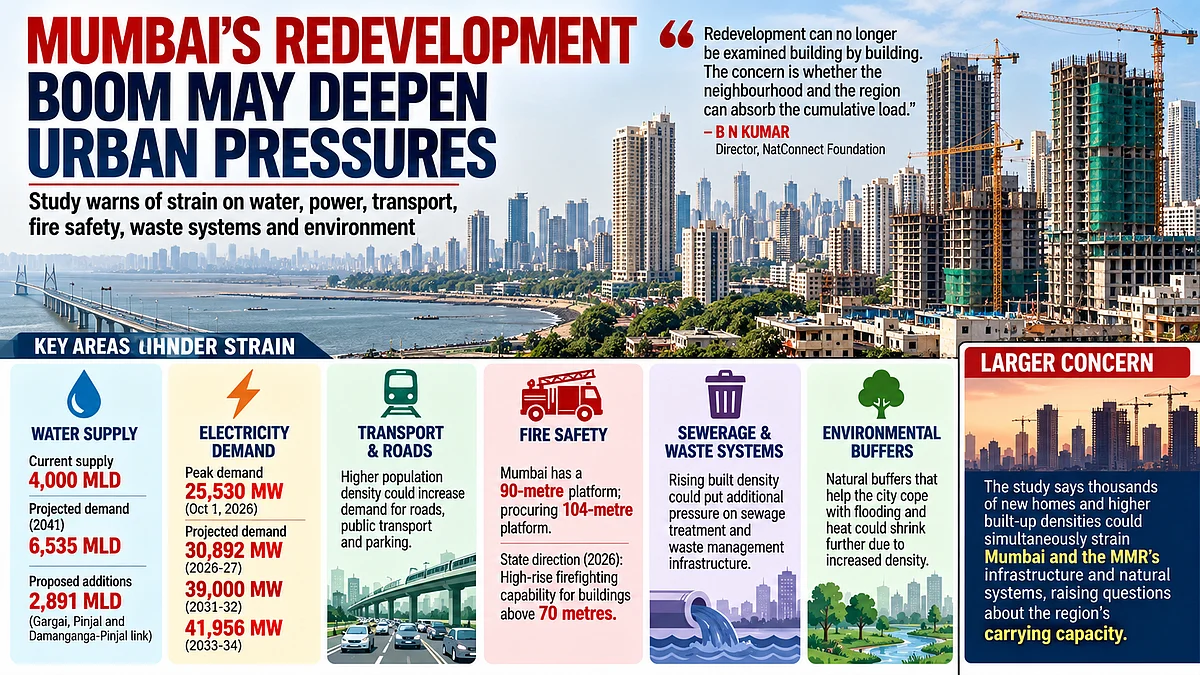
Mumbai and its surrounding region are experiencing a rapid redevelopment surge, which could potentially exacerbate the very urban stresses it aims to alleviate. According to a report by the NatConnect Foundation, "The City We Are Rebuilding," the increased density is straining key urban systems such as water, power, roads, transportation, fire response, sewerage, waste management, and environmental buffers. This sudden increase in built-up area is causing stress on the existing infrastructure and natural systems.
The study emphasizes that the redevelopment issue cannot be analyzed on a building-by-building basis. Thousands of new homes and a significant rise in built-up density could simultaneously increase demand for water, electricity, roads, public transport, parking, sewage treatment, waste management, and emergency services, all while reducing the natural buffers that help the city handle flooding and heat.
One of the immediate concerns highlighted is water supply. Mumbai currently generates around 4,000 million litres of water per day, but the projected demand by 2041 is expected to be 6,535 MLD. The proposed new water sources from Gargai, Pinjal, and Damanganga-Pinjal link would contribute an additional 2,891 MLD. The study also warns that electricity demand could surge as residential density rises, with projections suggesting a need for capacities of 30,892 MW by 2026-27, 39,000 MW by 2031-32, and 41,956 MW by 2033-34.
Fire safety is another pressing issue. With taller buildings, the current 90-meter hydraulic aerial platform may not suffice. Maharashtra's 2026 guidelines require high-rise firefighting capabilities for structures over 70 meters. The study points out that aerial reach alone is insufficient; factors such as approach roads, deployment areas, fire lifts, hydrants, pumps, refuge areas, alarms, smoke-control systems, and evacuation routes must also be considered.
Navi Mumbai’s Nagrik Manch convenor, Shrikant Patki, points out a widening gap between vertical growth and civic capacity. He urges for mandatory and transparent carrying-capacity assessments before any further high-density redevelopment. Patki argues that planning should go beyond just focusing on Floor Space Index (FSI) and floor space calculations, and should also incorporate liveability factors into the planning process.
Written by urgent.news from Free Press Journal's reporting — not their text. Machine-written — may contain errors; check the original before relying on it.