EU To Completely End Consumption Of Russian Gas By End Of 2027 — von der Leyen
The European Union plans to completely end its consumption of Russian gas by the end of 2027, European Commission President Ursula von der Leyen said on October 6, stressing that reducing dependence on Russian energy has made the bloc more resilient amid the current global energy crisis, UATV English relays. Speaking at the European Parliament in Strasbourg, von der Leyen recalled how Russia…
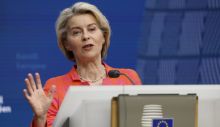
The European Union has announced plans to completely phase out its consumption of Russian gas by the end of 2027, according to European Commission President Ursula von der Leyen. Speaking at the European Parliament in Strasbourg on October 6, von der Leyen emphasized that reducing dependence on Russian energy has made the bloc more resilient during the ongoing global energy crisis, which UATV English reports.
The EU President recalled how Russia attempted to utilize energy supplies as leverage against Europe following the nation's full-scale invasion of Ukraine. "Four years ago, Russia sought to blackmail us. At that time, 45% of our gas imports were sourced from Russia. Almost overnight, nearly all supplies were cut off. However, Europe stood united, and we emerged stronger.
We diversified our supply sources," von der Leyen stated. She noted that EU countries have expedited investments in domestic clean energy in recent years. Consequently, the proportion of Russian gas in EU imports has decreased from 45% to approximately 12%. "We will bring it down to zero by the end of next year," von der Leyen affirmed.
Additionally, she highlighted the expansion of renewable and nuclear energy across the bloc, with more than 70% of the EU's electricity now generated from domestic clean sources, including renewables and nuclear power. Von der Leyen argued that the measures taken during the 2022 energy crisis have significantly diminished the EU's vulnerability to external energy pressure.
"Thanks to these decisions made during the crisis in 2022, we are less vulnerable today and are in a stronger position," she emphasized. The EU has been striving to further diminish its reliance on Russian energy while tightening restrictions on Moscow's ability to evade sanctions. Concurrently, Russia has been intensifying its efforts to sustain its energy exports, including through its so-called shadow fleet of tankers.
Written by urgent.news from UATV English's reporting — not their text. Machine-written — may contain errors; check the original before relying on it.