EU: China am „verwundbarsten Punkt“ treffen können: Merz und Macron wollen „Kill-Switch“ im Handelsstreit
Getrieben vom Bundeskanzler und Frankreichs Präsidenten rüstet die EU für Handelskriege auf. Das Handelsblatt enthüllt die Details einer Wirtschaftswaffe, die Peking an den Verhandlungstisch bringen soll.
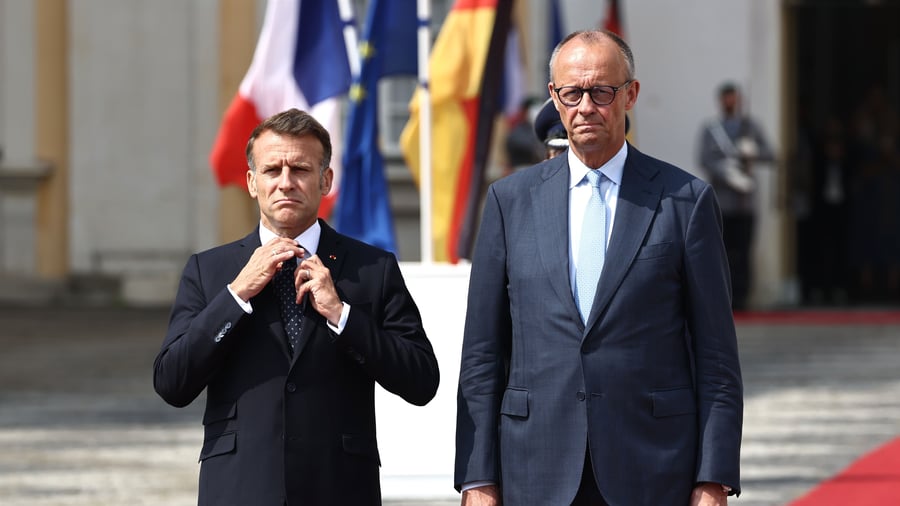
Germany and France aim to empower the EU with extensive new competencies to assert themselves in a trade dispute with China. The Commission would be authorized to quickly exclude Chinese companies from the European single market. This comes after concern that China may respond to planned EU protective measures for European industry with an export stop to critical raw materials.
Such restrictions previously forced European factories to cut production last year. The EU must be able to hit back, according to the conviction in Berlin and Paris. There is no reason "why we should not react when our sovereignty is at stake," said French President Emmanuel Macron. German Chancellor Friedrich Merz (CDU) has called on the EU to be more consistent in countering Chinese market distortions.
Merz and Macron plan to outline their demand in a joint paper before the EU summit on October 15th and 16th. Work on the powerful new trade instrument is already underway in the Commission. According to high-level EU officials, Commission President Ursula von der Leyen may announce the move at the summit. The Commission will then "present its torture chamber," says a high-ranking official.
A senior diplomat explains: "China's most vulnerable point is its dependence on the European market." The country relies on exports to the EU, precisely where the EU must act in case of an emergency. Time is running out. Chinese companies produce much more than they can sell domestically, aggressively pushing into export markets and putting German industry under severe pressure.
Economists speak of a "China shock." With the US having closed ranks with high tariffs, even more Chinese imports pour into Europe, exacerbating the industrial crisis. German industry association BDI reports 15,000 industrial jobs lost every month. Chancellor Merz blames China for "targeting market dynamics with state interventions, excess capacity, aggressive pricing, a devalued currency, and heavily subsidized exports."
"This puts our companies under massive pressure in the EU single market and also on third markets," he said in mid-September at the German Chamber of Commerce's entrepreneur day. The threat of market exclusion is meant to be the ultima ratio. Berlin and Paris hope a signal of European resolve will force China to make concessions, so the new trade instrument will never have to be used.
China expert Noah Barkin first reported on this. The German government generally continues to favor open markets and has no interest in effectively blocking China's access to the single market. The consequences would be disastrous for both sides. China is the EU's second-largest trading partner with a trade volume of 759 billion euros.
Berlin intends to bring China and even the US to the negotiating table with the disincentive mechanism and, if necessary, the US as well. The EU is to react within days, diplomats stress. The measures range from the exclusion of individual companies from the single market to trade restrictions against an entire country. Ultimately, it would amount to a kind of "kill-switch" (emergency switch).
The Commission could trigger it in an emergency. Member states could then change or stop it by qualified majority. This requires at least 55% of member states and 65% of the EU population. The speed of implementation is crucial, high-ranking officials stress: While existing EU protection instruments only kick in after months of scrutiny and lengthy negotiations in the council of member states.
The new tool should enable Brussels to respond within a few days to economic coercion by other states. The trade conflict between Europe and China resembles a standoff, with the EU preparing anti-dumping duties on Chinese hybrid cars - a move expected to trigger a Chinese counterattack, according to Brussels. Chinese ministry recently warned Europe against introducing "discriminatory restrictions" against Chinese companies or products, threatening retaliation if they do.
The EU has been wearily aware of this threat, but the kill-switch idea is not new. In late 2023, the EU decided on the "instrument against economic coercion." Before negotiations, member states insisted on retaining control, arguing that the commission cannot act before the states confirm a case of economic coercion. However, this mechanism proved insufficient, as powerful countries like China and the US could cripple the EU before the Commission could act.
The weakness of this arrangement was already debated during negotiations, but member states insisted on retaining control.
Written by urgent.news from Handelsblatt's reporting — not their text. Machine-written — may contain errors; check the original before relying on it.