CHIME Detects Ancient Hydrogen Using Its Own Data
The Canadian Hydrogen Intensity Mapping Experiment (CHIME) has detected ancient hydrogen from the early universe using only its own data, giving astronomers a new way to study the mysterious force behind the universe’s accelerating expansion. The radio telescope array near Penticton, British Columbia, scans the entire northern sky every day, but until now researchers had […]
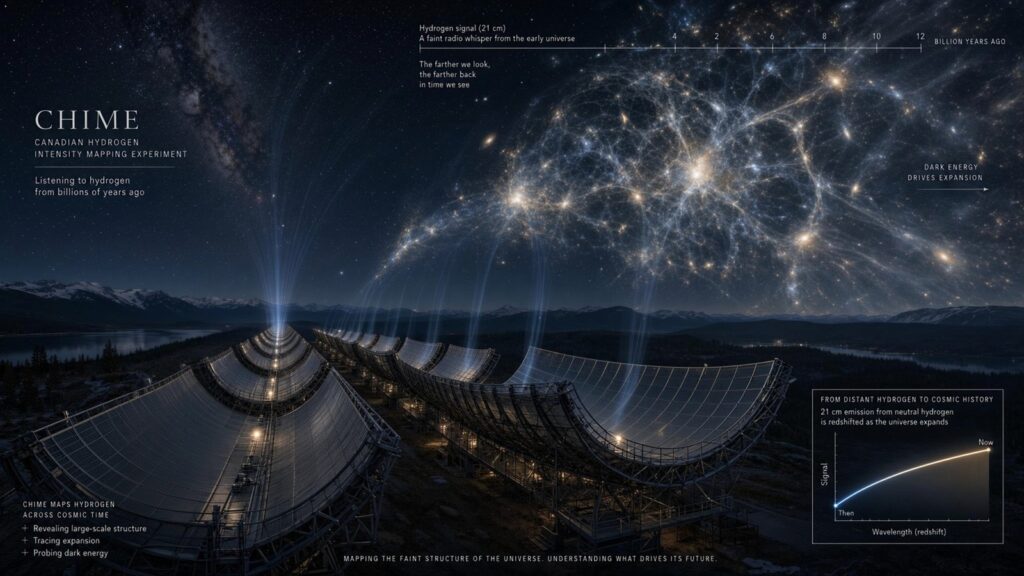
CHIME, a Canadian radio telescope, has discovered ancient hydrogen from the early universe using only its own data, providing astronomers with a novel method to study dark energy and cosmic expansion. The array of radio antennas, located near Penticton, British Columbia, observes the faint hydrogen signals from the distant universe daily.
Prior to this discovery, astronomers had to compare CHIME's observations with galaxy catalogs from other telescopes to trace the faint hydrogen signal. However, a study published on September 28 in The Astrophysical Journal reveals that CHIME can identify the signal by analyzing how its own maps vary across different regions, a technique known as autocorrelation.
The researchers detected hydrogen from 8 to 9 billion years ago after observing for 94 nights in 2019, with a high level of confidence that the signal is not a false alarm. This finding transforms a long-tested idea into a working method, allowing future hydrogen surveys to be faster and less reliant on external observations. The detection of ancient hydrogen could help astronomers measure the universe's expansion over time and explore whether dark energy remains constant or changes.
Written by urgent.news from Colombia One's reporting — not their text. Machine-written — may contain errors; check the original before relying on it.