Building a Modern Real-Time Data Pipeline from Scratch (With Architecture Diagrams)
Stop pipeline failures at 3 AM. Learn how to build a resilient, event-driven streaming data pipeline from scratch using Python, Kafka, and Airflow.
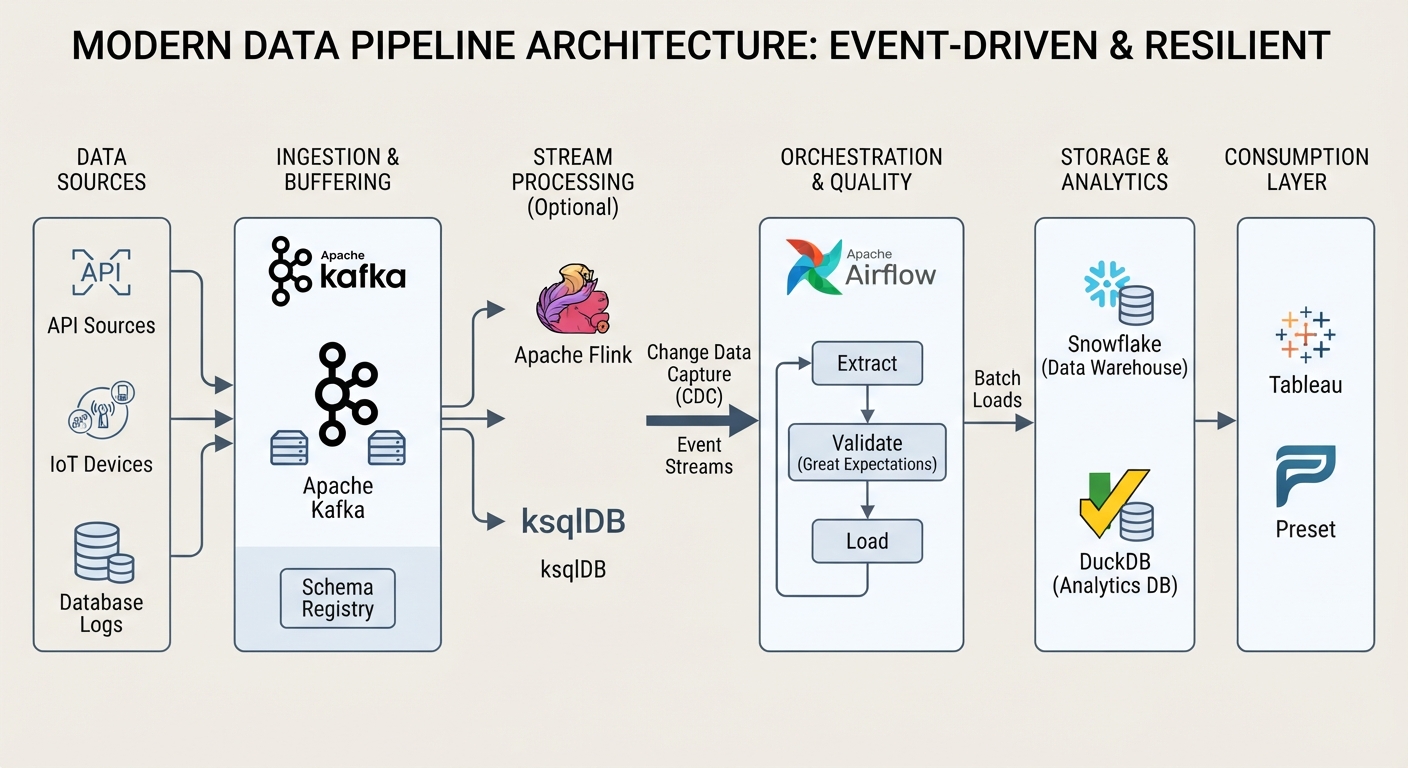
This article guides readers through creating a robust real-time data pipeline from scratch. The construction of a modern pipeline should begin with an architectural blueprint that separates ingestion, processing, and orchestration so that issues in one layer won't bring down the entire system.
Key components are utilized to facilitate a resilient pipeline: Apache Kafka serves as our reliable data buffer, Apache Airflow takes charge of managing dependencies and scheduled batch synchronization along with data quality checks, and finally, storage optimizes data for quick analytics.
The implementation involves a Python producer that pushes events to Kafka and an Airflow Directed Acyclic Graph (DAG) snippet that initiates downstream validation. To handle failures, a Dead-Letter Queue (DLQ) is introduced. When the ingestion worker encounters an invalid payload, instead of crashing the entire stream, it routes this issue to the DLQ, ensuring no complete system failure.
Observability is crucial in a modern data pipeline; metrics tracking freshness, distribution, volume, and schema changes are essential. With these improvements, an engineering team can shift away from fragile batch scripts to a more adaptable and observant real-time data pipeline that ultimately benefits stakeholders by minimizing the risk of silent failures.
Written by urgent.news from HackerNoon's reporting — not their text. Machine-written — may contain errors; check the original before relying on it.