Beyond wiring diagrams: Inside a $19 million effort to expand access to connectome technology
Davi Bock’s lab took the millions of images that led to the complete connectome of a fruit fly brain. Now he wants to apply “this high-throughput flashlight across all areas of biology.”
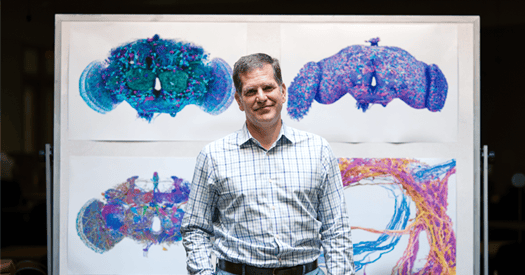
Davi Bock, a neuroscientist at the University of Vermont, has been awarded a $19 million grant from the U.S. National Science Foundation (NSF) to develop a "National Connectomics and Ultrastructure Volume Observatory." The observatory aims to bring the high-resolution volume electron microscopy (EM) technique to a wider range of biological research, rather than focusing solely on mapping larger and larger connectomes.
Bock's lab at Janelia Research Campus previously produced a complete wiring diagram of the fruit fly brain using volume EM, resulting in the FlyWire dataset.
The observatory will take on smaller projects requested by outside investigators, using volume EM to examine how biological structures change across different contexts. Four pilot projects have been planned, including studies of synaptic changes from learning in hippocampal circuits, the structure of shark retinas in various water conditions, the parasite Toxoplasma gondii crossing the blood-brain barrier, and mapping protein distribution in protists using expansion microscopy alongside volume EM.
Bock emphasizes the importance of spanning structural scales—from subcellular to whole-organism—to understand information processing in biological systems. The observatory will offer a web portal for inquiry submissions, with pricing explored during the implementation phase. The White House has shown interest in this work, as mentioned in the recent "Science: A New Golden Age" report, which acknowledges the value of connectome research for potential applications in artificial intelligence.
Written by urgent.news from The Transmitter's reporting — not their text. Machine-written — may contain errors; check the original before relying on it.