AI Is Breaking Developers’ Traditional Game Testing Playbook
Game testing has always been an unpredictability problem for developers. Players move in the wrong direction, trigger events out of order, or combine mechanics no designer anticipated. Even so, developers could usually define the rules governing the world and check whether the game followed them. AI is making that harder. NPCs now react to changing […]
Game testing has always been a challenge for developers due to the unpredictable nature of player interactions and game mechanics. However, the introduction of artificial intelligence (AI) into game development is making this task even more difficult. NPCs now react to changing conditions and select behaviors based on the surrounding environment, rather than following a fixed sequence of actions. This can create a more immersive gaming experience, but it also makes it harder to define the rules that govern the game world.
The traditional game testing process involves creating a matrix that covers all possible combinations of game states and interactions. However, as games become more complex, with additional features such as physics engines, real-time movement, character states, inventory systems, dialogue trees, and multiple paths through the same scene, the testing surface grows exponentially.
For example, consider an NPC responding to a player's actions in a scripted system. In a traditional system, the NPC would follow a predetermined path and deliver a specific line of dialogue, which is an expected result. However, when AI is introduced, the NPC's response can vary based on the player's location, earlier interactions, nearby objects, or the actions of other characters.
This creates an almost infinite number of possible responses, making exhaustive testing impractical.
While scripted testing is still essential for known functionality, regression testing, and core mechanics, it can no longer catch bugs that arise from complex combinations of actions and states. Human testers are still valuable for their ability to judge whether movement feels wrong, a mechanic is poorly balanced, or an interaction negatively impacts the player's experience. However, they cannot exhaust every possible combination of actions, and this limitation was already evident before AI entered the picture.
The gaming industry has responded to this challenge by leaning more heavily on automation. By 2026, approximately 47% of gaming studios reported using AI for QA and playtesting, with these studios reporting a 30% to 40% reduction in testing costs. Companies like Square Enix have set ambitious goals to automate up to 70% of their QA pipeline by 2027.
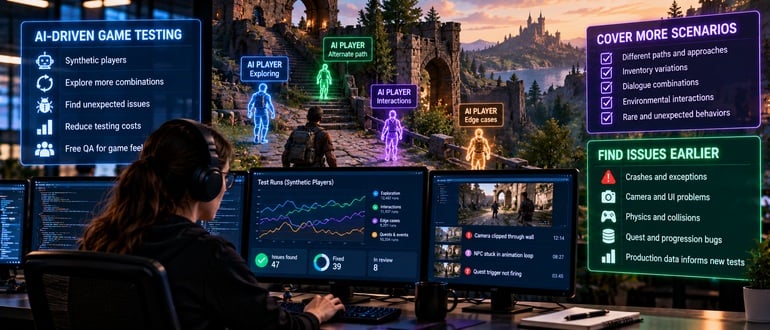
This shift towards AI-driven QA processes is leading to new methods of testing, such as deploying synthetic players that can continuously explore game worlds, interact with mechanics, and try different combinations of actions.
These synthetic players offer several advantages over human testers, including the ability to spend more time on rare or complex interactions that might be overlooked by a human tester. For instance, a synthetic player might discover an error caused by a specific combination of inventory choices or dialogue options that a human tester would rarely repeat.
However, this does not eliminate the need for human testers. Instead, it shifts their focus to aspects such as game feel, balance, pacing, and the overall player experience.
Traditional post-release testing methods, such as crash reporting and investigation, are becoming less effective as games become more complex. This has led to the development of production data analytics, which can help identify the most critical issues affecting players. For example, Roblox, a game with over 10 million players, uses advanced error reporting capabilities to aggregate crash reports, group related errors, and classify them based on diagnostic information.
This allows Roblox to quickly identify the most significant crashes and improve the accuracy of their reporting system. The result has been a 50% increase in monthly active users, demonstrating the value of this data-driven approach to game development.
In conclusion, the integration of AI into game development is creating new challenges for game testing, particularly in terms of defining the rules that govern complex game worlds. While automation is helping to address some of these challenges, it is essential to recognize that human testers still play a crucial role in ensuring that games are enjoyable, balanced, and free from critical bugs.
By combining AI-driven automation with human expertise, the gaming industry can continue to push the boundaries of what is possible while maintaining high-quality standards.
Written by urgent.news from DevOps.com's reporting — not their text. Machine-written — may contain errors; check the original before relying on it.