Unblurring the boundary of civil-military relations
Clear legal limits, accountability and safeguards are needed to ensure exceptional assistance does not become an administrative norm.
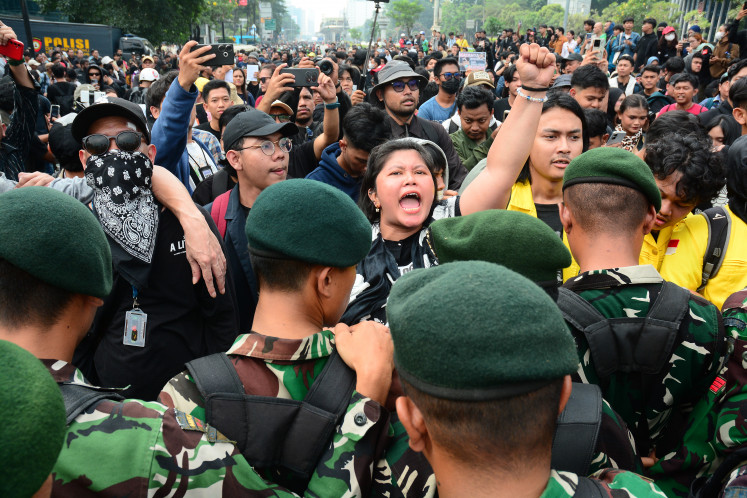
Indonesian media has highlighted the growing military presence in civilian programs, signaling a shift from occasional exceptionalism to a normalized administrative practice. The People's Consultative Assembly (MPR) decree TAP MPR No.VI/2000 on the separation of the armed forces and the National Police provides a solid foundation for addressing this issue, indicating the direction of security-sector reform in line with the 1945 Constitution amendment.
The dual role of the armed forces in civilian governance has hindered democratic progress, yet the decree did not prohibit military involvement; it merely established a new context of democratic control. While civil-military studies typically overlook domestic governance domains, military officers often assume national leadership positions due to their education, skills, and managerial abilities.
General Abdul Haris Nasution's "middle way" approach aimed to integrate military participation in state governance for nation-building and bureaucratic efficiency, later evolving into the dual functions (dwi fungsi) doctrine of the Indonesian Military (TNI). The expansion of the military's role was influenced by the condition of the state and the capabilities of civilian institutions at the time.
Indonesia now boasts a more advanced and specialized civilian bureaucracy compared to the 1950s and 1960s. However, Morris Janowitz, in "Military Institutions and Coercion in the Developing Nations," argues that the military's role as an agent of modernization has been overstated, as military institutions' capacity to manage administrative and technical functions diminishes as their involvement in broader sectors increases. Janowitz contends that military capabilities cannot replace civilian administrative expertise.
Written by urgent.news from The Jakarta Post's reporting — not their text. Machine-written — may contain errors; check the original before relying on it.