Soldiers Sweeping for Land Mines in South Korea Have Unearthed the Country’s Oldest Gun, a 600-Year-Old Inscribed Bronze Tube
The artifact was found in 2023 during a metal detecting survey. Experts have been analyzing it since and recently confirmed its authenticity
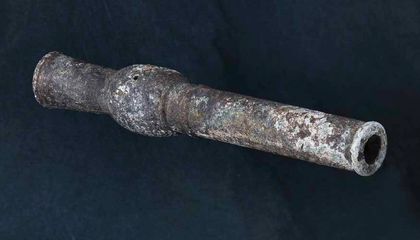
South Korean researchers have discovered the country's oldest known gunpowder weapon, a ten-inch bronze hwatong or "fire tube," dating back to either the 14th or 15th century. The artifact was uncovered during a routine mine-detection sweep on Geumseongsan Mountain in Naju in 2023. Experts have since been studying the 2.2-pound weapon, which is inscribed with 28 Korean characters.
Translated, the characters read, "In the 12th month of the Jeongsa year, the Hwangja Hwatong was made. Its weight is one geun and 14 nyang. Supervised by Noksa An Hyu-bo; made by the artisan Seok." Hwangja designates a class, geun and nyang are traditional weight units, and Noksa is the title of the official who oversaw its creation.
The hwatong falls between the late Goryeo and early Joseon dynasties, a time when physical artifacts of firearms are rare. Researchers have translated the inscription's date as either 1377 or 1437, making the hwatong the earliest gunpowder weapon found in Korea. Gunpowder originated in ninth-century China, initially used only in fireworks and signals before being packed into bamboo tubes to create early guns in the tenth century.
By the late 1200s, metal guns had replaced bamboo tubes, and the technology spread. The Korean peninsula was ruled by the Goryeo dynasty, which is the origin of the Western word "Korea," during this period. The 14th century saw the popularity of firearms grow in Korea, with Korean scientist Choi Mu-Seon persuading the Goryeo dynasty to establish a directorate of gunpowder weapons in 1377.
The hwatong found on Geumseongsan Mountain may have been used by Koreans defending their land against Japanese pirates who sailed up the Yeongsan River. The artifact fills a gap in the country's firearm development history.
Written by urgent.news from Smithsonian's reporting — not their text. Machine-written — may contain errors; check the original before relying on it.