Neutrons, Rotating Black Holes, and a Galactic PeVatron at the Center of the Milky Way
Supermassive black holes generate tremendous amounts of energy through their accretion disks and jets. But they can also generate energy through the magnetic Penrose process. A new study looks at how we might observe this process through multimessenger astronomy.
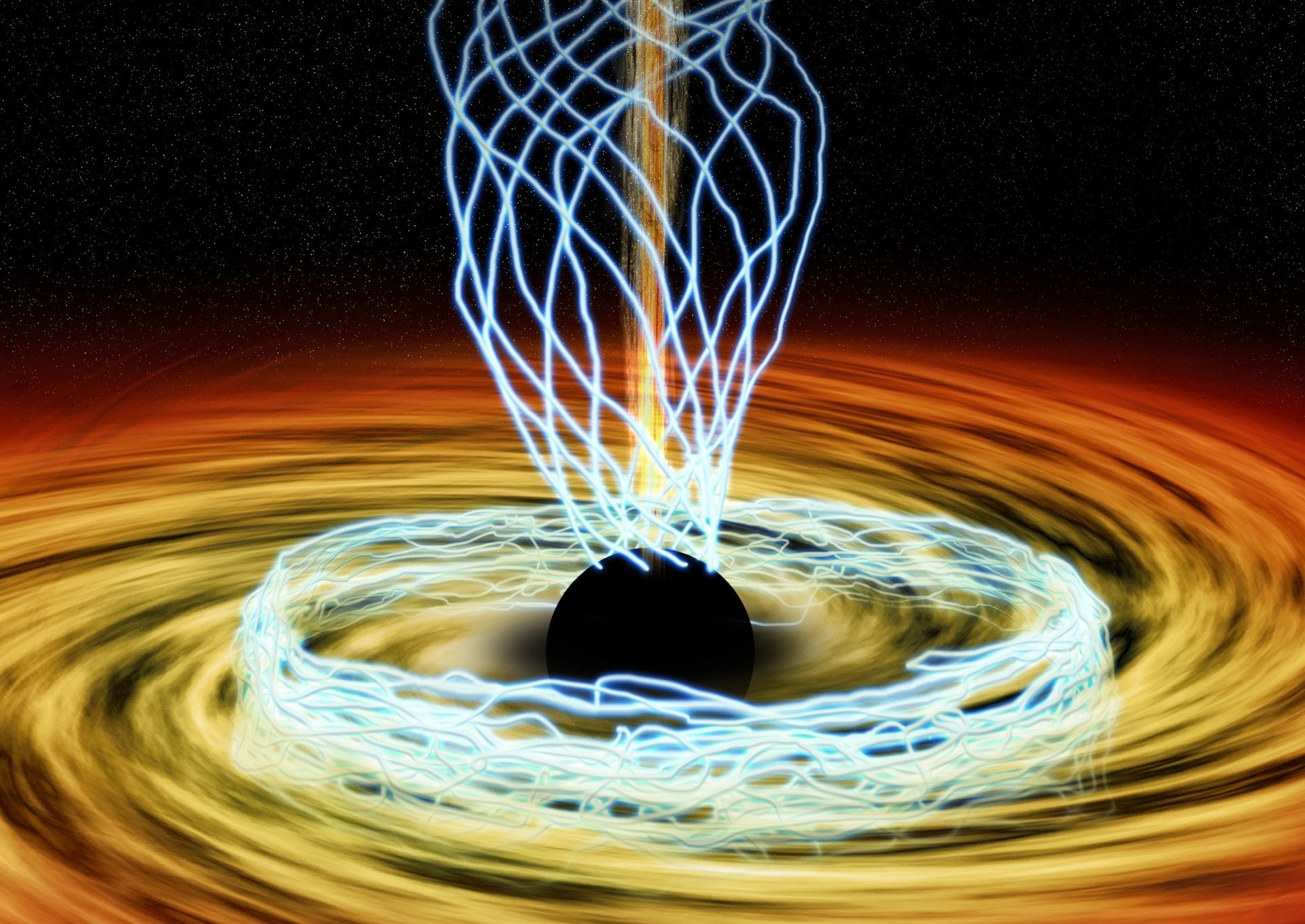
Black holes, those cosmic powerhouses, are like the mitochondria of galaxies, generating energy from their surroundings. While most of this energy comes from the material in their accretion disks, a new study suggests there might be a more direct method: the Penrose process. Proposed by physicist Roger Penrose in 1969, this mechanism allows for the extraction of energy directly from a rotating black hole, reducing its total mass. This differs from the usual process where black holes gain mass by consuming matter.
The key to this process lies in the ergosphere, a region around a rotating black hole where space is dragged along by the black hole's rotation. Within this region, the effects of relativity become particularly pronounced. If a spaceship were to enter the ergosphere, it would be forced to rotate around the black hole, and by dumping useless cargo that falls into the black hole, the spaceship could gain a boost in speed.
This would allow it to escape with more energy than it started with, as the black hole absorbs the negative energy of the falling debris.
While this concept is purely theoretical, a new study proposes a potential real-world scenario involving a neutron within the ergosphere of Sagittarius A*, the supermassive black hole at the center of the Milky Way. Neutrons, which have no net electric charge, can decay into a proton, an electron, and a neutrino. This decay process is akin to dumping space trash.
The proton, now boosted in energy due to its interaction with the magnetic field in the ergosphere, could reach incredibly high energies, in the PeV (peta electron volt) range – a thousand times more powerful than those produced in particle accelerators like the Large Hadron Collider.
If these high-energy protons were to escape the ergosphere at near-light speed, they would collide with gas molecules near the black hole, emitting intense gamma rays with a distinctive spectral signature. Additionally, the decay process would also produce high-energy neutrinos, offering astronomers the opportunity to observe a multi-messenger signal – light and neutrinos – from this unique phenomenon.
While the current technology is not sensitive enough to detect these faint signals, future upgrades to observatories like the High-Altitude Water Cherenkov (HAWC) and the IceCube Neutrino Observatory in Antarctica may be able to capture these elusive signals, potentially providing evidence of the Penrose process and demonstrating that black holes can lose mass.
Written by urgent.news from Universe Today's reporting — not their text. Machine-written — may contain errors; check the original before relying on it.
This story
This is one outlet's version. Read the fullest account.