Inventors of optogenetics win Nobel Prize in Physiology or Medicine
Karl Deisseroth, Peter Hegemann and Georg Nagel are joint winners of the 2026 prize The post Inventors of optogenetics win Nobel Prize in Physiology or Medicine appeared first on Physics World .
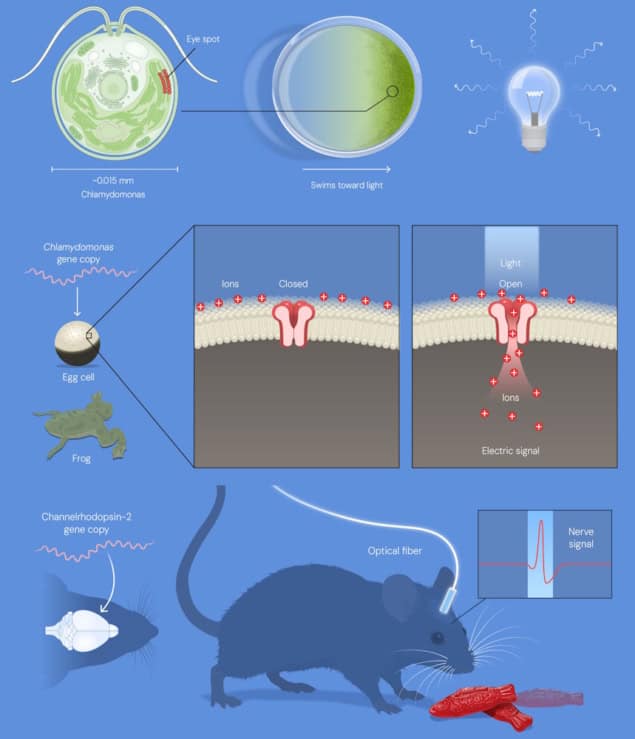
In 2026, the Nobel Prize in Physiology or Medicine was awarded to three scientists: Karl Deisseroth, Peter Hegemann, and Georg Nagel, for their groundbreaking work on "discovering light-gated ion channels and optogenetics." Optogenetics is a technique that employs light to regulate the activity of neurons within a living brain.
Hegemann and Nagel independently discovered the light-sensitive protein channelrhodopsin, while Deisseroth adapted the protein into a light-controlled switch for nerve cells. According to Per Svenningsson, chair of the Nobel Committee for Physiology or Medicine, "Optogenetics provides opportunities for mapping the brain in a way that we could once only dream of."
The discovery of channelrhodopsin began with Chlamydomonas algae, which could sense light through an "eyespot" on its surface. Hegemann investigated how this organism could convert light into action, eventually identifying a light-sensitive protein that instantly transformed light into an electrical signal. Together with Nagel, Hegemann successfully introduced the gene for Chlamydomonas into frog egg cells, leading to the development of a light-gated ion channel.
Deisseroth, studying the causal links between specific brain circuits and behavior, tested the potential of channelrhodopsin as a switch to control neurons with light. By introducing the protein's DNA into mammalian neurons and illuminating them with light, Deisseroth observed that the neurons responded instantaneously and with millisecond precision.
To confirm that light could control neurons in living animals, Deisseroth and his colleagues introduced the channelrhodopsin gene into specific nerve cells in the brains of living mice. By shining light through a thin optic fiber, they activated selected groups of neurons and induced desired behaviors. This development, known as optogenetics, revolutionized neuroscience, allowing researchers to establish causal connections between neural activity and behavior.
Since its inception, optogenetics has been widely adopted globally and has led to a better understanding of neural circuits associated with various functions, including pain, social behaviors, and reward. It has also shed light on how disruptions in these circuits can contribute to psychiatric and neurological conditions. While optogenetics primarily serves as a tool for basic research, it also shows potential for therapeutic applications, such as restoring visual function in individuals with retinitis pigmentosa through the insertion of a channelrhodopsin-like protein in their retinas.
Written by urgent.news from Physics World's reporting — not their text. Machine-written — may contain errors; check the original before relying on it.