Illicit diesel blending threatens SA fuel market
FIASA estimates that diesel blended with illuminating paraffin accounts for 5% to 7% of South Africa’s market, with up to 800 million litres sold annually, as higher prices increase the incentive for illegal mixing.
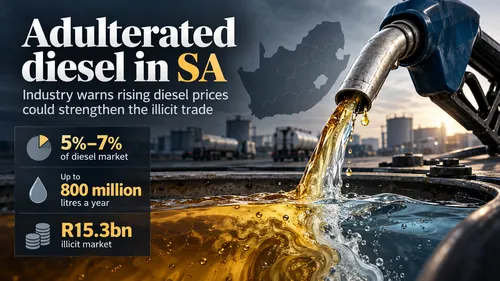
South Africa's diesel market could be compromised by illicit blending with illuminating paraffin, with recent industry research indicating up to 7% of the fuel could be contaminated, equating to 800 million litres annually, according to the Fuels Industry Association of South Africa (FIASA). This illicit trade, valued at R15.3 billion, results in tax losses of between R3.6 billion and R4.2 billion per year.
FIASA warned that this issue poses a significant threat to the South African fuels industry, as it exploits a R6.03-a-litre tax gap between diesel and paraffin. Diesel prices are expected to rise sharply this month, potentially making discounted illicit fuel more attractive to customers. Research shows illegal blenders can discount adulterated diesel by up to R3.02 per litre before breaking even.
Despite this, increased diesel prices alone do not confirm adulteration, but any significant price discrepancy should warrant concern. Illuminating paraffin sales have surged from 620 million litres in 2019 to 1.4 billion litres in 2023, before decreasing in 2024. While this increase alone doesn't prove adulteration, it's consistent with some demand being driven by financial incentives to blend paraffin into diesel.
In 2024, 70 out of 1,070 fuel samples taken from service stations across South Africa failed compliance tests, with the A1 marker from illuminating paraffin detected. The South African Revenue Service (SARS) reported a national trend of illegal mixing, detaining 953,515 litres of contaminated diesel and registering 13 criminal cases.
Hauliers have reported contaminated-fuel incidents, leading to significant repair costs and downtime. The Department of Mineral Resources and Energy warned that adulterated diesel can accelerate wear in high-pressure pumps and injectors, with warning signs including increased fuel consumption, reduced power, and rough running. FIASA advised buying from reputable suppliers and checking for verifiable licences and quality certificates, urging tighter monitoring of paraffin through the supply chain and increased fuel testing at depots and distribution points.
Written by urgent.news from IOL's reporting — not their text. Machine-written — may contain errors; check the original before relying on it.