Ex-USFK commander warns time-based OPCON transfer could weaken deterrence against N. Korea
WASHINGTON, Oct. 5 (Yonhap) -- A former commander of U.S. Forces Korea (USFK) wa...
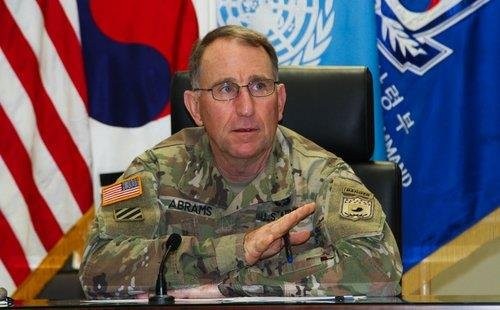
Former U.S. Forces Korea (USFK) commander Retired Gen. Robert Abrams cautioned on Monday that hastening the transfer of wartime operational control (OPCON) to South Korea with a set timeline could heighten security risks and diminish the alliance's deterrence against North Korea. During a webinar hosted by the Center for Strategic and International Studies, Abrams discussed the ongoing efforts between the U.S. and South Korea to transfer wartime OPCON from Washington to Seoul.
According to Abrams, setting a deadline for the OPCON transfer inherently raises risks due to potential operational shortcomings on the part of the Republic of Korea (ROK) military. He emphasized that Seoul and Washington must ensure a robust force and capability on the Korean peninsula and in the region to effectively deter North Korea.
Abrams argued that establishing a specific date for the transition without guaranteeing South Korea's acquisition of the necessary military capabilities could create gaps in the alliance's defense posture. South Korea has been striving to regain wartime OPCON before the five-year term of President Lee Jae-myung ends in 2030, or even earlier. Notably, South Korea retook peacetime OPCON in 1994, while the U.S. still retains wartime OPCON.
The allies initially agreed in 2007 to transfer wartime OPCON by April 2012, but the handover has been postponed multiple times due to North Korea's advancing nuclear and missile programs. In October 2014, the allies agreed on a conditions-based OPCON transition plan, which requires South Korea to lead the future combined command and secure critical strike capabilities to counter North Korea's threats, while ensuring a conducive regional security environment for the OPCON handover.
Abrams also disputed a claim that South Korea had achieved 92 percent completion in the requirements for the OPCON transition process as of 2020. He firmly stated that this figure was not consistent with the facts, as he was the commander in Korea in 2020 and was not convinced that the ROK was near 92 percent completion. He acknowledged that he was not fully informed about South Korea's current progress due to the classified nature of the process, but expressed confidence that there were still numerous shortcomings.
Gen. Xavier Brunson, the current USFK commander, has stressed that political expediency should not take precedence over military readiness in the OPCON transition process.
Written by urgent.news from Yonhap News's reporting — not their text. Machine-written — may contain errors; check the original before relying on it.