Chandra X-ray Observatory Drops New View of our Galaxy’s Unruly Centre
The core of the Milky Way is a dense, active, messy region, dominated by a supermassive black hole called Sagittarius A* (Sgr A*) hiding at the heart of the galaxy. But Sgr A* is only a supporting actor in this stunning new image from the Chandra X-ray Observatory.
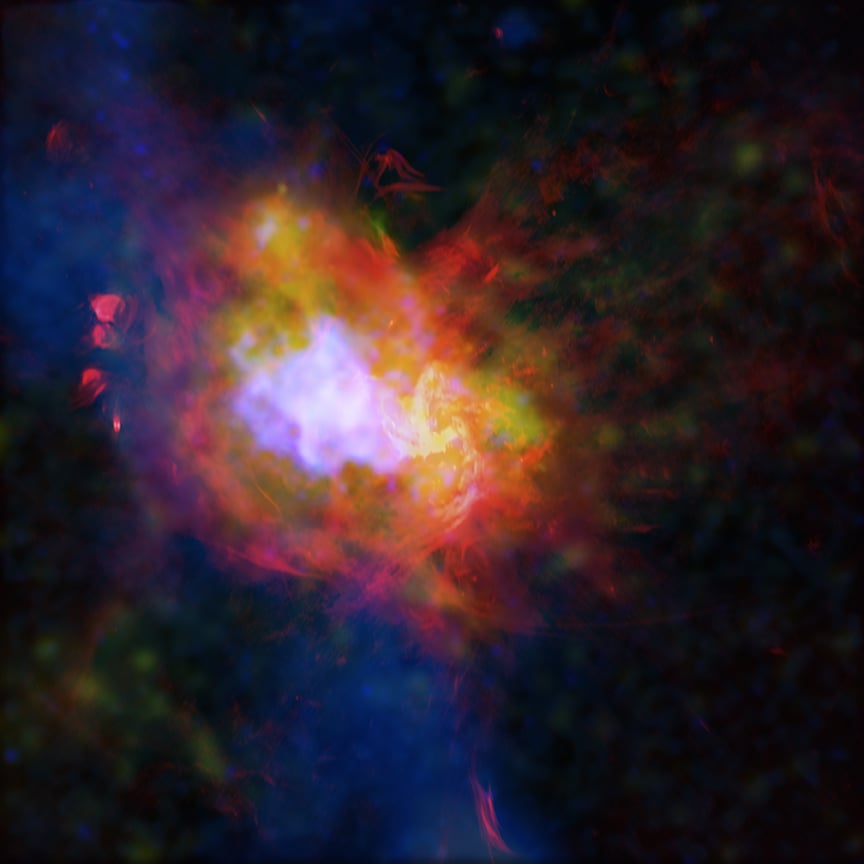
The Chandra X-ray Observatory has unveiled a stunning new image of our galaxy's unruly core, focusing on a supernova remnant known as Sagittarius A East (Sgr A East). This dramatic view showcases the supernova remnant, illuminated like a cosmic chandelier, dancing in front of the supermassive black hole Sagittarius A* (Sgr A*), which lies at the heart of the Milky Way. The supernova exploded around 10,000 years ago, leaving behind a red ring surrounding a hot blue core.
To separate the Chandra's view of Sgr A East from other X-ray sources, astronomers employed a special technique. This allowed them to study the diffuse emission and map elements like iron, sulfur, argon, and calcium. The image is a combination of three different wavelengths: high-energy X-rays in blue, lower-energy X-rays in green, and radio waves in red. The submillimeter data from the James Clerk Maxwell Telescope adds a deeper, dark blue hue to the scene.
The findings suggest that Sgr A East and the black hole aren't just neighbors but are in a turbulent relationship, actively influencing each other and their surroundings. The supernova remnant has expanded, compressed, and shock-heated the surrounding molecular material, potentially carving cavities that shape the three-dimensional structure of the region. This work has also allowed researchers to see more clearly which X-ray signals come from which source, separating out various elements within the supernova explosion.
Written by urgent.news from Universe Today's reporting — not their text. Machine-written — may contain errors; check the original before relying on it.