Artemis Arena
Overview The Artemis Arena at NASA’s Kennedy Space Center offers a premier testbed for external customers seeking to validate systems in a simulated lunar mare environment. The arena is filled with Black Point-1 (BP-1) crushed basalt, a high-fidelity lunar regolith simulant representative of the Moon’s basaltic maria. Enclosed within internal dimensions of approximately 6.8 meters in length by…
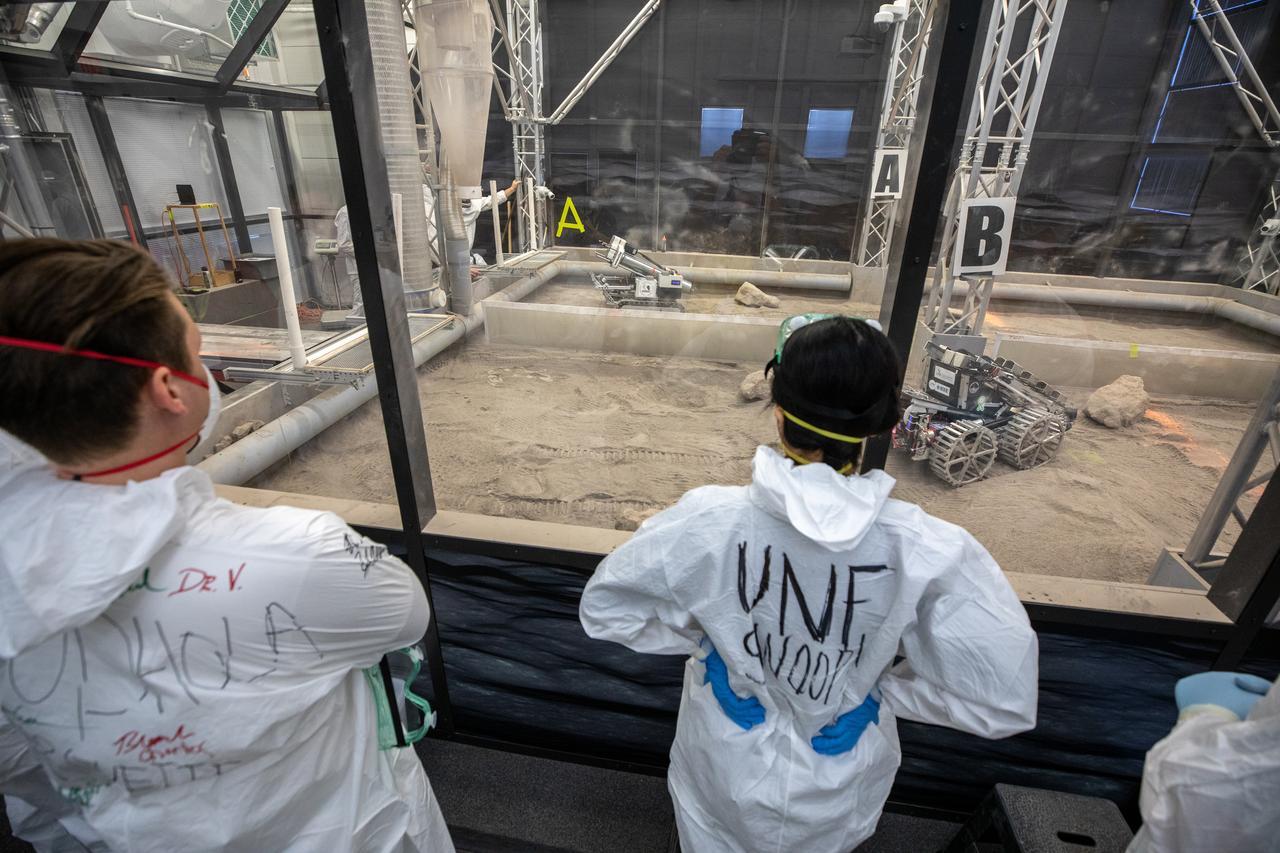
The Artemis Arena, located at NASA's Kennedy Space Center, serves as a cutting-edge testbed for external customers aiming to validate their systems in a simulated lunar environment. This arena is filled with Black Point-1 (BP-1) crushed basalt, a high-fidelity lunar regolith simulant that closely resembles the Moon's basaltic maria.
Spanning approximately 6.8 meters in length and 5.0 meters in width (measured between internal ducts), the arena offers a substantial 45 cm depth of BP-1. To replicate natural heterogeneity, larger rocks and gravel (about 2 cm in diameter) can be randomly interspersed within the BP-1.
The centerpiece of the arena is the Obstacle Zone, meticulously designed to challenge teams in developing technologies for obstacle detection, terrain mapping, and autonomous navigation. This zone features a slalom route with randomly placed boulder obstacles, each roughly 30 to 40 cm in diameter and varying in height. These obstacles may also be present in the excavation zone but will not exceed the size of those in the obstacle zone.
The arena also includes crater obstacles, with shapes that vary and dimensions no larger than 40 to 50 cm in depth or width. A central structural column within the arena acts as a fixed infrastructure obstacle, further enhancing the realism by simulating a persistent hazard that must be navigated around.
This facility offers a controlled and realistic setting for a variety of tests, including robotics, mobility, excavation, and autonomy, all under conditions that closely mimic the Moon's terrain. It is accessible to industry, academic, and government teams gearing up for future lunar missions.
Written by urgent.news from NASA Science's reporting — not their text. Machine-written — may contain errors; check the original before relying on it.
This story
This is one outlet's version. Read the fullest account.
- Artemis Arena nasa.gov