AI finds bafflingly complex but beautiful symmetrical Venn diagram
Creating rotationally symmetrical Venn diagrams of increasing size is a longstanding mathematical challenge - now an amateur has used AI to generate the largest ones yet
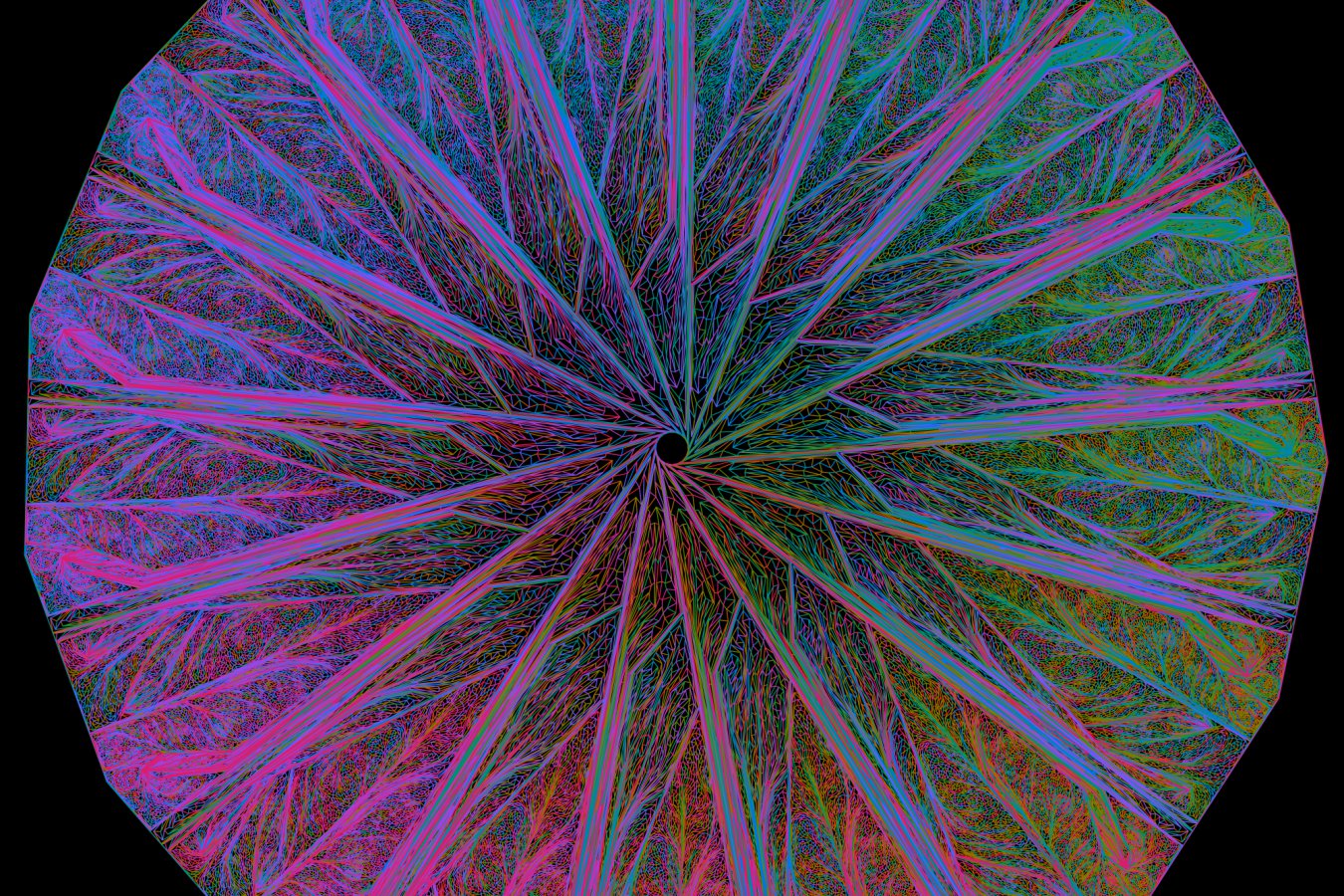
In a recent discovery, artificial intelligence has uncovered a remarkably intricate and visually captivating Venn diagram featuring 17 sets. This complex diagram, characterized by its delicate segments and rotational symmetry, represents a significant milestone in the field of mathematics. Venn diagrams, which illustrate all possible relationships between sets, are typically depicted using three or four circles; however, their complexity can be expanded theoretically to accommodate any number of circles.
Despite this potential, creating symmetrical Venn diagrams with a substantial number of sets has long been a captivating challenge for mathematicians. It has been proven that these symmetrical diagrams can only be constructed using a prime number of sets, and when these sets are kept simple, with no more than two curves intersecting at any point, the process becomes even more difficult.
In 2012, an 11-set Venn diagram meeting these criteria was discovered, followed by another with 13 sets in 2014. Software developer Chris Dzoba was inspired to utilize AI to search for a 17-set Venn diagram. He established a communication platform for two AI models, Anthropic's Claude Fable and OpenAI's GPT-6 Astra, to collaborate and develop an algorithm that could provide a solution to the problem.
Within just three days, the AI models successfully identified the 17-set diagram. Subsequently, he tasked the models with discovering a 19-set Venn diagram, which they achieved on a subsequent Sunday. Currently, Dzoba is actively investigating the possibility of finding a Venn diagram with 23 sets, though this endeavor will necessitate additional cloud computing resources to support the complex algorithm.
This remarkable achievement is yet another testament to the growing influence of AI in mathematical discoveries, showcasing how amateur-led initiatives can yield groundbreaking results when combined with accessible technology. The development of AI-powered tools has enabled individuals like Dzoba, who are not formally trained mathematicians, to make substantial contributions to the field.
Moreover, the progress in computing power has played a crucial role in facilitating these breakthroughs. Dzoba emphasizes the dramatic improvements in computational speed, noting that in the past, a key obstacle was reaching the 13-set diagram, which represented a clear stopping point. With current advancements, the boundaries of what is computationally feasible are continuously expanding, potentially paving the way for even more ambitious discoveries in the future.
Stanford University mathematician Stan Wagon, who has recently worked at Macalester College in Minnesota, describes the AI-generated 17-set diagram as "spectacular," highlighting the intricate nature of the curves that, upon closer examination, reveal a level of detail that ensures its accuracy and validity.
Written by urgent.news from New Scientist's reporting — not their text. Machine-written — may contain errors; check the original before relying on it.