100 Jahre: Wie Mercedes-Benz zur Weltmarke aufstieg
Vor genau 100 Jahren wurde die wertvollste Premiummarke geboren: Auf dem Berliner Automobilsalon feierte Mercedes-Benz 1926 seine Premiere. Ein Rückblick auf eine bewegte Geschichte.
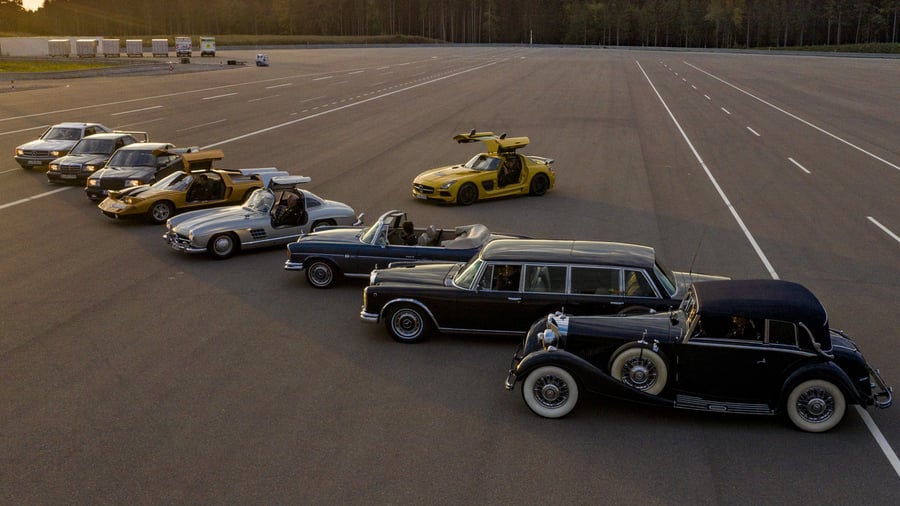
100 years ago, the rival automobile pioneers Benz and Daimler merged to form Daimler-Benz AG in Berlin, introducing the three-star emblem of the new premium brand Mercedes-Benz at the glamorous Berlin automobile showrooms in October 1926. The first Mercedes-Benz product lineup offered desirable yet affordable technical finesse, outshining established luxury brands like Bugatti, Hispano-Suiza, Horch, and Maybach.
Key world premieres in the year of the star included the 1926 Mercedes-Benz 8/38 PS (W02) and 12/55 PS (W03), as well as the tourer car typ K („kurz“ with compressor) as a precursor to the legendary sportscar line S, SSK, and SSKL. In addition to passenger cars, Mercedes-Benz also showcased a completely new vehicle lineup featuring revolutionary front-liner concepts.
Experts deemed the merger of the world's two oldest automobile builders as a masterstroke, allowing shareholders to exchange securities in the new company. Mercedes-Benz remains the most valuable premium automobile brand today, according to rating experts like Interbrand. Its success is due to the continuous reinvention of the brand, which has proven its uniqueness even in the face of setbacks like the diesel emission scandal and debates over the future of the affordable A-Class model.
Throughout its history, Mercedes-Benz has weathered various crises, including the Great Depression of 1929 and the challenging years of the Nazi regime. Despite these challenges, the company quickly regained its leading position in the premium segment after World War II, with its first diesel passenger car (type 260 D) introduced in 1936, legendary racing and record cars, and robust mid-size models.
Mercedes-Benz became a symbol of the post-war economic miracle, with the 1951 introduced Mercedes 300 gaining the unofficial nickname "Adenauer" as it became the preferred vehicle of the first German chancellor Konrad Adenauer.
The Mercedes-Benz brand's association with motorsport has also contributed to its mythological status. Formula 1 silver arrows and the 1954 introduced Mercedes 300 SL with its distinctive gullwing doors have become iconic in the world of automotive icons. The 300 SLR Uhlenhaut Coupé, as the 300 SLR, fetched a staggering 135 million euros at auction, making it the most expensive car in history.
However, the Mercedes star also symbolizes bourgeois prosperity, representing a social success sign for those who can afford it. The S-Class, introduced in 1972, is the brand's premium flagship, while the SL series, known for its "Pagoda roof" design and the 1971 launched R107 Roadster with V8 power, have become synonymous with luxury and are often featured in movies and television shows.
Written by urgent.news from Handelsblatt's reporting — not their text. Machine-written — may contain errors; check the original before relying on it.