Uniform Civil Code: A Polarising Code Under Uniformity Cover?
Ideological promises and proposals for a Uniform Civil Code (UCC) have been a contentious issue in India for decades, primarily because it involves the sensitive question of the relationship between religion and state. Seeking to replace religion-based personal laws governing marriage, divorce, inheritance, co-habitation, and other things like property rights with a common set of rules that apply…
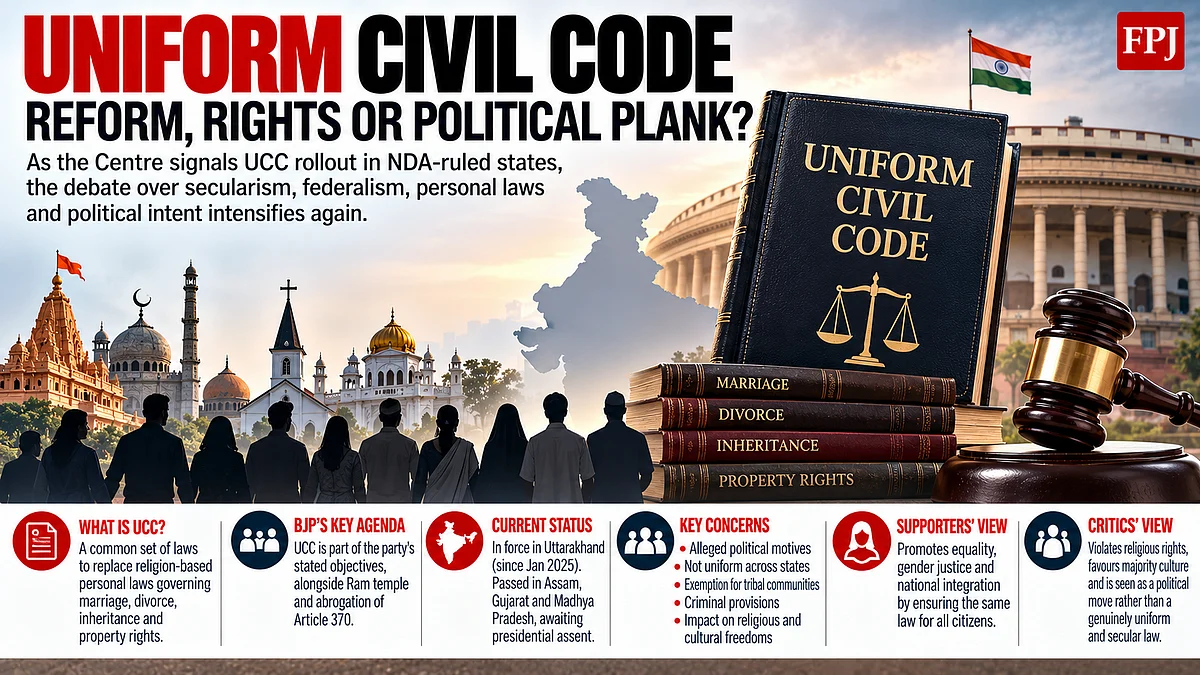
The Uniform Civil Code (UCC) has been a contentious issue in India for decades, often sparking debates over the relationship between religion and state. While the aim of a UCC is to provide a common set of rules for marriage, divorce, inheritance, and other matters that apply to all citizens equally, the proposal has faced opposition due to its potential impact on religious and cultural freedoms.
In India, personal laws governing various aspects of life are rooted in religious scriptures and traditions, with each major religious community following its own set of rules. The UCC, envisioned as a secular and egalitarian code, remains an ideal rather than a reality, largely due to political debates surrounding its constitutionality and the potential infringement on fundamental rights.
The BJP, currently in power, has been vocal about its support for the UCC, alongside other contentious issues such as the construction of the Ram temple in Ayodhya and the abrogation of Article 370. However, concerns have been raised about the motives behind implementing the UCC, particularly given the timing and the potential for it to become an electoral plank for the party.
The lack of a parliamentary majority has led the government to enact UCC laws at the state level, but these statutes are not uniform across states, leading to criticism over their lack of consistency.
Opposition parties and critics argue that the UCC is neither civil nor uniform, as it criminalizes violations and interferes with the right to equality and freedom of choice. They contend that a law which is neither uniform nor civil violates constitutional rights and fails to promote justice, unity, and the ideals of a truly secular code. Some of the BJP's allies, like the JD(U) and the Telugu Desam Party, have also expressed reservations about the UCC's rollout in NDA-ruled states.
The UCC debate centers on the tension between individual rights and group rights. While it is argued that secularism implies equal treatment for all citizens, irrespective of their religious beliefs, critics claim that it infringes on the rights of communities with unique customs and traditions. The UCC is seen by some as a tool for majoritarianism, undermining the principle of secularism, which is intended to be inclusive and respect all religions and belief systems equally.
Ultimately, the UCC is a complex issue that requires careful consideration of the delicate balance between individual rights and the rights of communities. It is essential to address concerns about uniformity and the protection of minority rights while striving to achieve the noble goal of a secular and egalitarian legal system for all citizens of India.
Written by urgent.news from Free Press Journal's reporting — not their text. Machine-written — may contain errors; check the original before relying on it.