Bosnia votes in general election with wartime divisions still dominating
Bosnia is heading to the polls on Sunday after a general election campaign dominated by parties that identify closely with the ethnic divisions of its 1990s war. Voters will elect a vast number of officials across multiple tiers of government, in a complex system that has held the partitioned country together since the 1995 peace deal. FRANCE 24's correspondent in Belgrade Laurent Rouy has more.
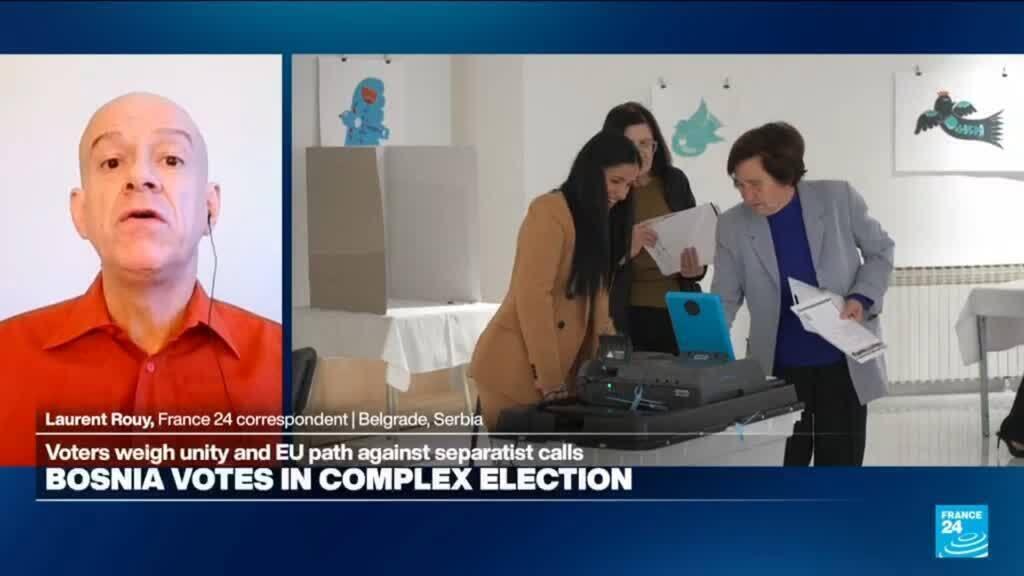
Bosnia was set to hold its general election on Sunday, with the campaign dominated by parties that closely identify with the ethnic divisions of its 1990s war. The election will see the election of officials at various levels of government, within a complex system established since the 1995 peace deal that partitioned the country.
The key race will be for the tripartite presidency, comprising Bosnian Muslims (Bosniaks), Serbs, and Croats. However, the parties' repeated focus on war-era rhetoric and division has frustrated some voters. Adi Selman, an activist with the Karton Revolucija protest group, expressed disappointment, stating that the limited choices offered by the same political parties that have been in power for 30 years would not change anything.
The Dayton agreement, brokered by the US, ended the 1992-1995 conflict but entrenched divisions that often hinder decision-making. The divided Bosnia into two semi-autonomous entities: the Serb-run Republika Srpska (RS) and a Muslim-Croat federation, linked by a weak central government. In the RS capital Banja Luka, former entity president Milorad Dodik's face dominates campaign posters and billboards.
Despite being convicted and banned from the presidency for six years, Dodik remains a central figure, with his separatist rhetoric leading to clashes with central authorities and impeding political cooperation. Dodik warned that Bosnia and Herzegovina was "dead, it is an impossible country." In the Muslim-Croat federation, Bosniak parties are seeking a stronger central state, with incumbent Bosniak presidency member Denis Becirovic pledging a renewed path to the European Union and NATO.
However, little progress has been made in recent years, according to researcher Adnan Cerimagic. Croat nationalist parties are also demanding greater influence in choosing the Croat member of the presidency. Environmental activist Sara Tusevljak criticized the political deadlock, stating that many young Bosnians have left the country due to the lack of opportunities and the feeling that their state had nothing to offer them.
Voting began delayed in dozens of polling stations due to technical issues, as the country implemented biometric identification and scanning technology for the first time. First results are expected late on Sunday.
Written by urgent.news from Kyiv Post's reporting — not their text. Machine-written — may contain errors; check the original before relying on it.
This story
This is one outlet's version. Read the fullest account.
- Bosnia Votes with Wartime Divisions Still Sominating kyivpost.com