Your RAG Pipeline Dies on Real Documents: Here's Why
RAG fails on PDFs because a PDF stores glyph positions, not document structure. Tables flatten, reading order scrambles, and no error is ever raised.
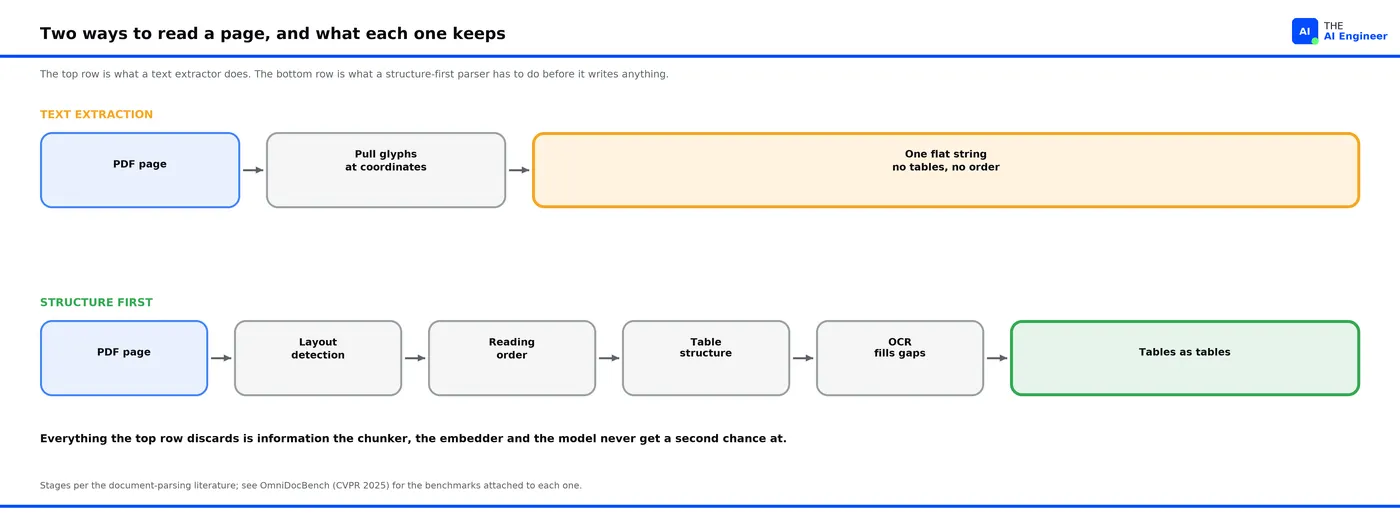
Retrieval-Augmented Generation (RAG) pipelines often fail when confronted with real-world documents, such as PDFs, scanned forms, and other non-clean data sources. The issue arises because the downstream parser in the pipeline removes crucial document structure, resulting in answers built from text that arrives in the wrong order or from flattened tables without column headers.
A PDF, for example, is merely a set of drawing instructions rather than a direct representation of the document's content. It lacks inherent structure like tables, headers, or reading order, making it challenging for the parser to extract meaningful information. Furthermore, many PDFs do not include accessibility tags that would otherwise provide the necessary structure.
When a document-understanding parser like LlamaParse encounters a PDF, it may fail to recognize tables, scramble reading order, or omit critical visual elements like charts and annotations. These issues can lead to the retrieval layer returning incorrect or nonsensical answers, even if no error message is generated.
Sending raw page images directly to a vision-capable model can partially solve the problem, but it comes with its own set of challenges. The cost of running a powerful model on many pages can be prohibitive, and the results may still lack the consistency and accuracy of a well-designed parser.
Ultimately, the failure of RAG pipelines with real documents highlights the importance of a robust document-understanding parser in the pipeline. Skipping the parser may seem like a quick solution, but it often leads to inconsistent results, higher costs, and a compromised understanding of the underlying document structure.
Written by urgent.news from HackerNoon's reporting — not their text. Machine-written — may contain errors; check the original before relying on it.