Reintroduction of tigers in Buxa: What it means for conservation | Explained
The release of the tigress is not is not merely about bringing tigers back to Buxa but its “objective is to create the conditions in which a tiger population can establish, breed and ultimately become viable and self-sustaining,” PIB said in a statement.
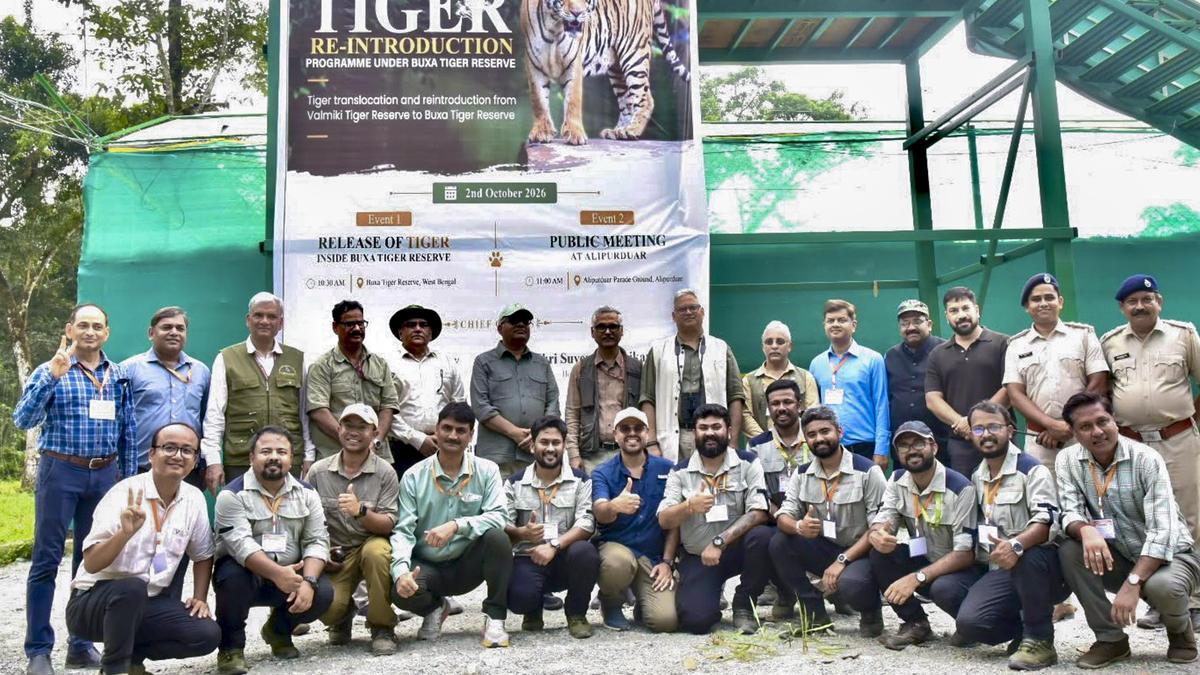
On October 2, 2026, a three-year-old tigress named T138 was released into the Buxa Tiger Reserve in West Bengal, marking the start of a phased program aimed at reintroducing tigers and establishing a self-sustaining population in the reserve. This initiative, which will see two to three more tigers added to the reserve, has been absent of significant tiger presence for several years.
The tigress was transferred from Bihar's Valmiki Tiger Reserve and released alongside Union Environment Minister Bhupender Yadav and West Bengal Chief Minister Suvendu Adhikari.
The tigress will initially be confined to a 2.3-hectare area to enable her to adapt to her new surroundings before being released into the larger reserve. She will be closely monitored using telemetry, camera traps, and field-based observation to assess her movement, adaptation, health, and behavior. The release is not just about bringing tigers back to Buxa; it aims to create conditions for a viable, self-sustaining tiger population, says the Press Information Bureau.
Buxa Tiger Reserve, declared in 1983 and the 15th tiger reserve in India, spans 760.87 sq km in the Alipurduar Sub-division of Jalpaiguri District, West Bengal. Its location, spanning 50 km east-west and 35 km north-south, is linked to Bhutan's forests to the north, Kochugaon forests, Manas Tiger Reserve to the east, and Jaldapara National Park to the west.
One reason for the low tiger density is habitat degradation and fragmentation due to increased human activity. Over the decades, habitat changes and prey availability decline have significantly affected the ecological conditions necessary for a stable resident tiger population. In 2018, the National Tiger Conservation Authority initiated a tiger reintroduction program at Buxa, Dampa, and Palamu reserves, leading to the successful re-introduction of tigers at Buxa.
Scientists and forest officials sought a habitat similar to Buxa for tiger translocation. Valmiki Tiger Reserve in Bihar, located in the easternmost part of the Terai Arc Landscape, was considered suitable due to its terrain similarities with Buxa. However, translocating tigers from the Sundarbans to Buxa may not work due to the vast differences in terrain and habitat. India's tiger reintroduction is the world's first scientific endeavor in this field, says the National Tiger Conservation Authority.
Tiger reintroduction in India has been a collaborative effort between the NTCA, state governments, and the Wildlife Institute of India, resulting in increasing tiger populations in reserves since its initiation in 2008. The reintroduction has been successful in Sariska and Panna Tiger Reserves, but not uniformly across all reserves.
Challenges, such as adaptation difficulties and human-tiger conflict, have been encountered. The NTCA has developed a protocol for tiger re-introduction, addressing aims, objectives, team constitution, feasibility studies, site selection, release stock suitability, and socio-economic requirements. In Buxa Tiger Reserve, about 300 families have relocated to facilitate the reintroduction, despite surrounding settlements and tea estates.
The region's proximity to Bhutan and heavy commercial traffic on the Bhutan-West Bengal road through Buxa add to the challenges.
Written by urgent.news from The Hindu's reporting — not their text. Machine-written — may contain errors; check the original before relying on it.
This story
This is one outlet's version. Read the fullest account.