Global trade is shifting from globalisation to fragmentation: QNB
Global trade was the driving economic force of the early 21st century. Between 2000 and 2024, world trade in goods and services nearly quadrupled, and the ratio of trade to global output climbed to a ...
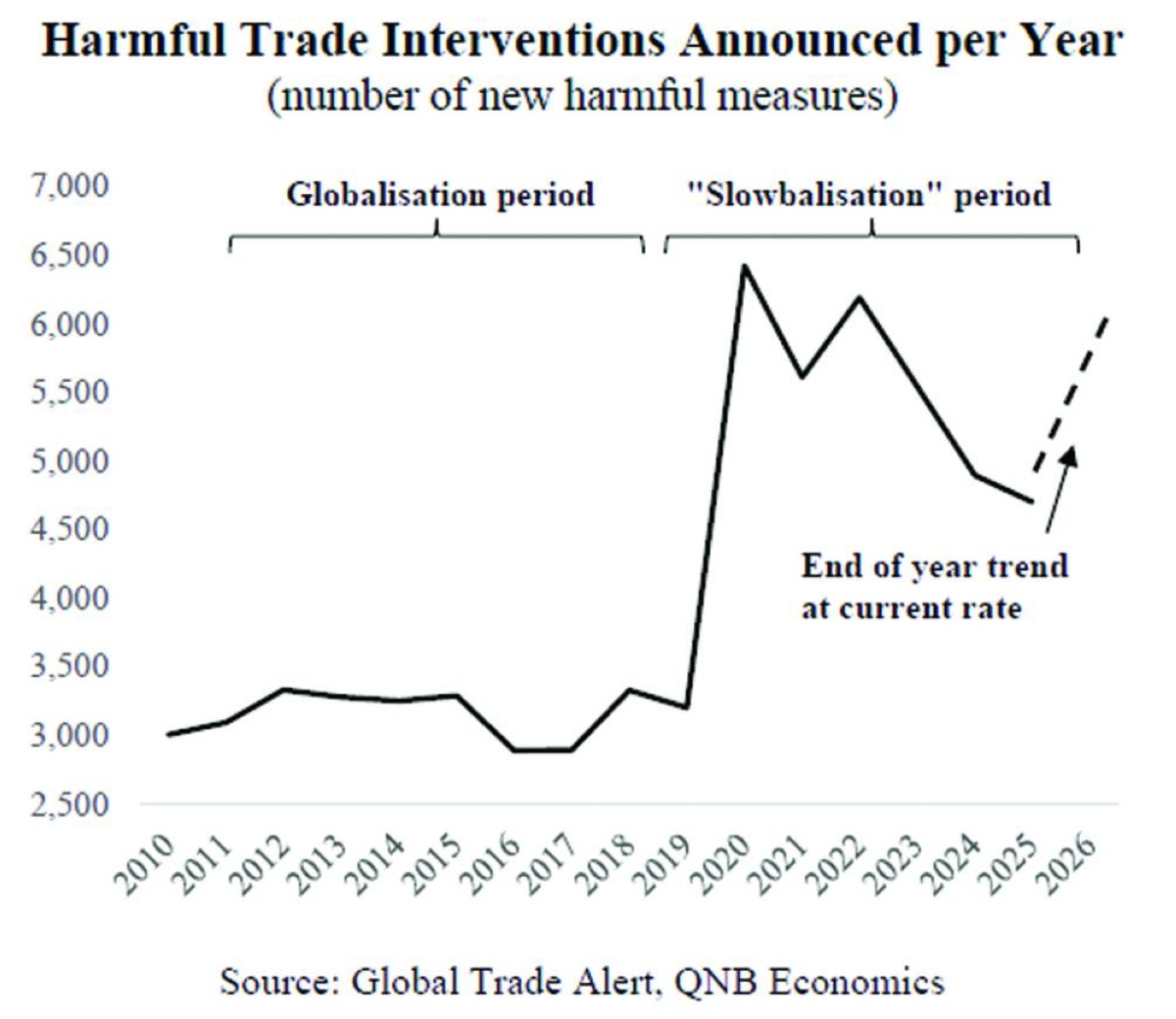
Global trade has transitioned from a period of rapid expansion in the 2000s to a more fragmented and protectionist landscape in recent years, according to QNB's economic commentary. The expansion, driven by factors such as China's WTO accession, global value chains, and declining trade costs, resulted in a near-quadrupling of world trade between 2000 and 2024, with the trade-to-GDP ratio reaching a peak of around 60%.
However, this growth began to slow after the 2008 global financial crisis, leading to a phase known as "slowbalisation," where trade growth stagnated and the ratio of trade growth to overall economic growth became more balanced. The most recent phase is marked by a surge in trade restrictions and protectionism, with the number of trade-restrictive measures doubling from the 2010s to the 2020s.
This shift has led to higher tariffs, increased trade-policy uncertainty, and a growing trend of commerce directed towards more reliable partners, often along geopolitical lines. While global trade has shown resilience and the ability to adapt, the more recent shift towards protectionism raises concerns about its long-term implications for global growth, prices, and the development prospects of emerging economies.
Written by urgent.news from Gulf Times Business's reporting — not their text. Machine-written — may contain errors; check the original before relying on it.
This story
This is one outlet's version. Read the fullest account.