Chartbook 477 Against historic normalization: Why AI is not the Manhattan project and why we must challenge ourselves to think the radically new.
Given the extremity of our moment there is an understandable desire to look to history as a possible source of orientation: hegemonic succession, fascism, the nuclear arms race, Cold War 2.0, middle-income trap, Japan 1990s etc are all commonly invoked.
Given the gravity of our present circumstances, many people find it natural to draw parallels with historical events such as hegemonic succession, fascism, the nuclear arms race, or even the middle-income trap. While these comparisons may offer a sense of comfort and provide a useful framework for discussion, they often serve to comfort us rather than accurately reflect the reality of our situation.
In most cases, history ends with a clear resolution, but our current predicament may not follow the same pattern. The nuclear arms race, for instance, was successfully managed, and the "West emerged victorious in the Cold War." Similarly, we assume that if a country experiences a middle-income trap, its growth will inevitably decline, and the global hierarchy will once again become apparent.
However, these analogies frequently share a common structure: they begin with uncertainty, then turn to historical narratives, and finally arrive at a reassuring conclusion, even though the actual outcome may be dire. If the consequences of these stories were truly dire, why would we invoke them so casually? To avoid this unsettling outcome, we must shift our focus subtly.
When discussing the threat of a new fascism, we do not typically reference the Holocaust or World War II. Instead, we compare it to the Manhattan Project, avoiding discussion of the catastrophic consequences at Hiroshima and Nagasaki. This approach raises a crucial question: what is wrong with seeking solace in a comforting story as a call to action?
And what is the harm in rallying allies to a battle we might just win? However, there is also a significant risk involved in this approach. We not only underestimate the severity of the threat but also overlook the historical novelty of our current situation. We must recognize that we may not be part of a familiar franchise, but rather, we may be in a radically new and unprecedented script.
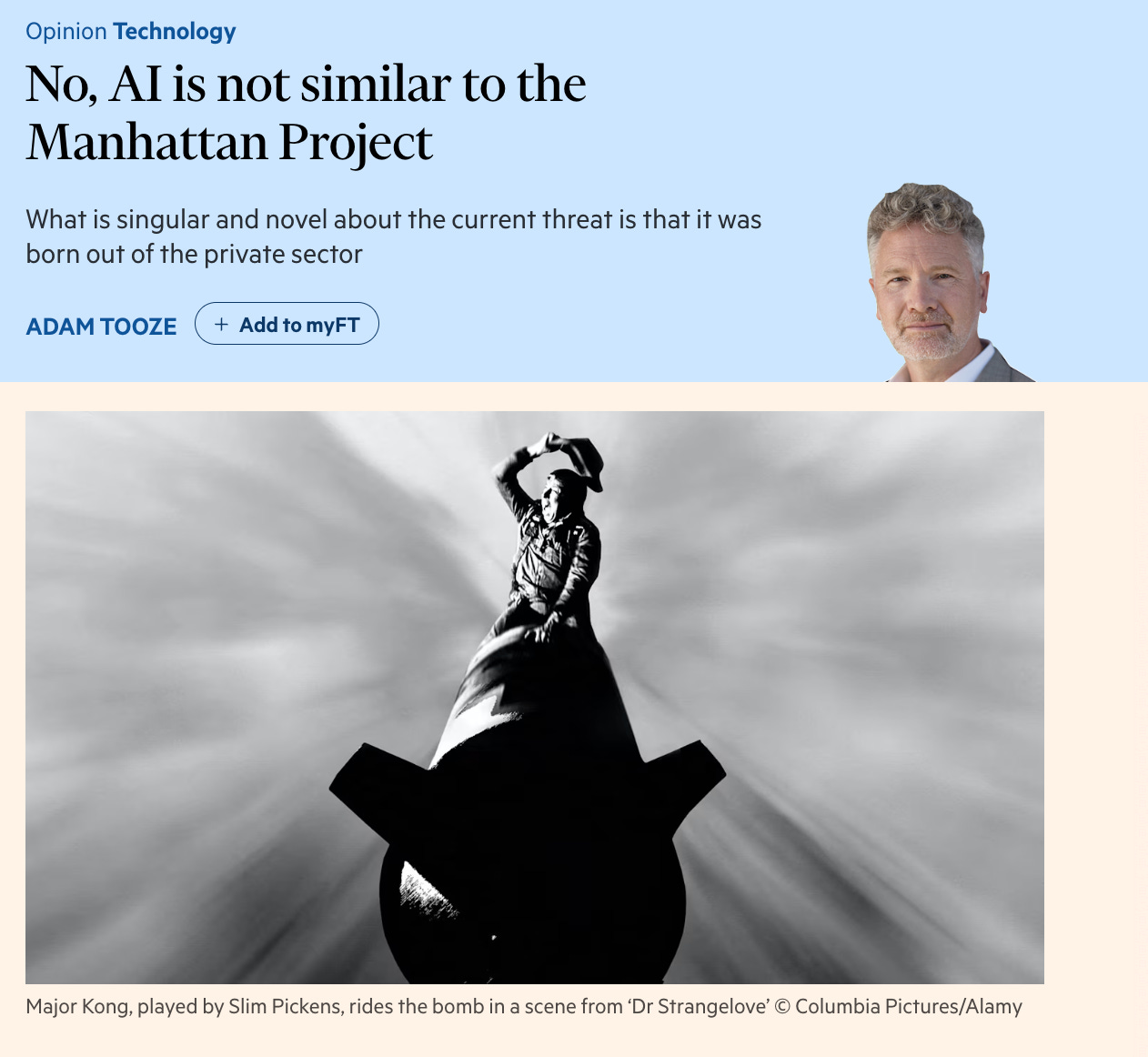
As I argued in the Financial Times, the current AI race is not merely a re-run of the Manhattan Project.
Written by urgent.news from Chartbook's reporting — not their text. Machine-written — may contain errors; check the original before relying on it.