On Children’s Books: Faith Ringgold’s The Invisible Princess
Asha Futterman, whose poem “Study of Children” appears in our new Fall issue, on the unsettling harmony of Faith Ringgold’s 1998 fairy tale.
"The Invisible Princess" is a 1998 children's fairy tale written and illustrated by artist Faith Ringgold. The story follows Patience, the blind daughter of an evil slave master named Captain Pepper, and the Invisible Princess, who is the daughter of two slaves named Mama and Papa Love. The Invisible Princess was born to her parents after they were told by the Great Lady of Peace that she would bring peace and freedom to their plantation.
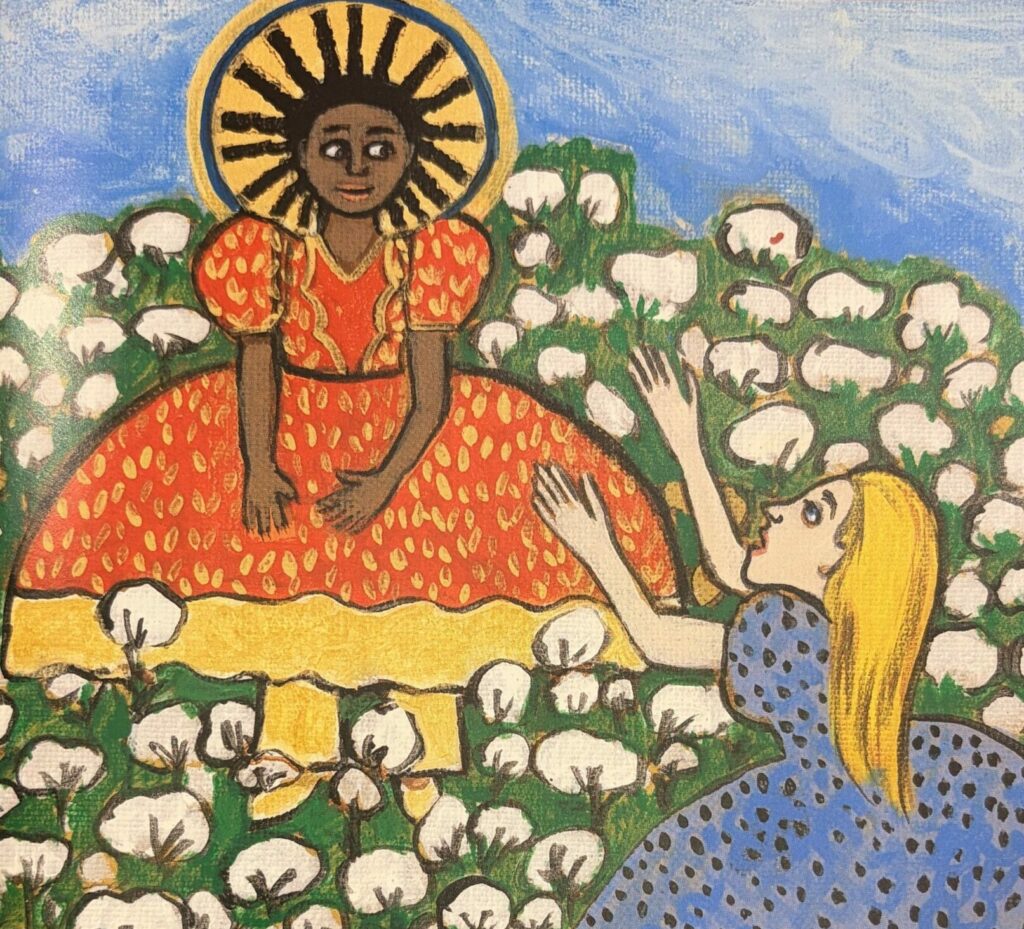
As a child, the author of this account remembered staring at a picture of Patience and the Invisible Princess in a flat field, with empty expressions but with Patience gesturing up toward the spectral princess in red. The book does not vary much in the expressions of its characters, with the most evil character, Captain Pepper, and the kindest one, the Great Lady of Peace, wearing the same soft smile.
The Invisible Princess resembles the other characters but is described as the most beautiful princess in the world due to the halo depicted around her. The author notes that when little kids look at Ringgold's renderings of the characters and are asked to identify who is good, who is bad, who is beautiful, and who is ugly, they might give different answers.
In the story, there exist two villages: the Village of Visible, which is filled with slavery and pain, and the Invisible Village of Peace, Freedom, and Love. While the text draws rigid lines between the two villages, the images in Ringgold's paintings are harmonic and flat, blurring the boundaries between the two worlds. The plantation depicted in the book is described as beautiful, but only for white people, as they send their children to school while slave children work all day in the cotton fields and are forbidden to read or write.
The contrast between the plantation and the slaves' broken-down shacks is inherent to the plantation and the eerie harmony of the painting's composition.
Written by urgent.news from The Paris Review's reporting — not their text. Machine-written — may contain errors; check the original before relying on it.