Mala Iqbal Paints the Space We Share With Strangers
Her new paintings remind us that the world is a room we share with strangers, most of whom are looking elsewhere.
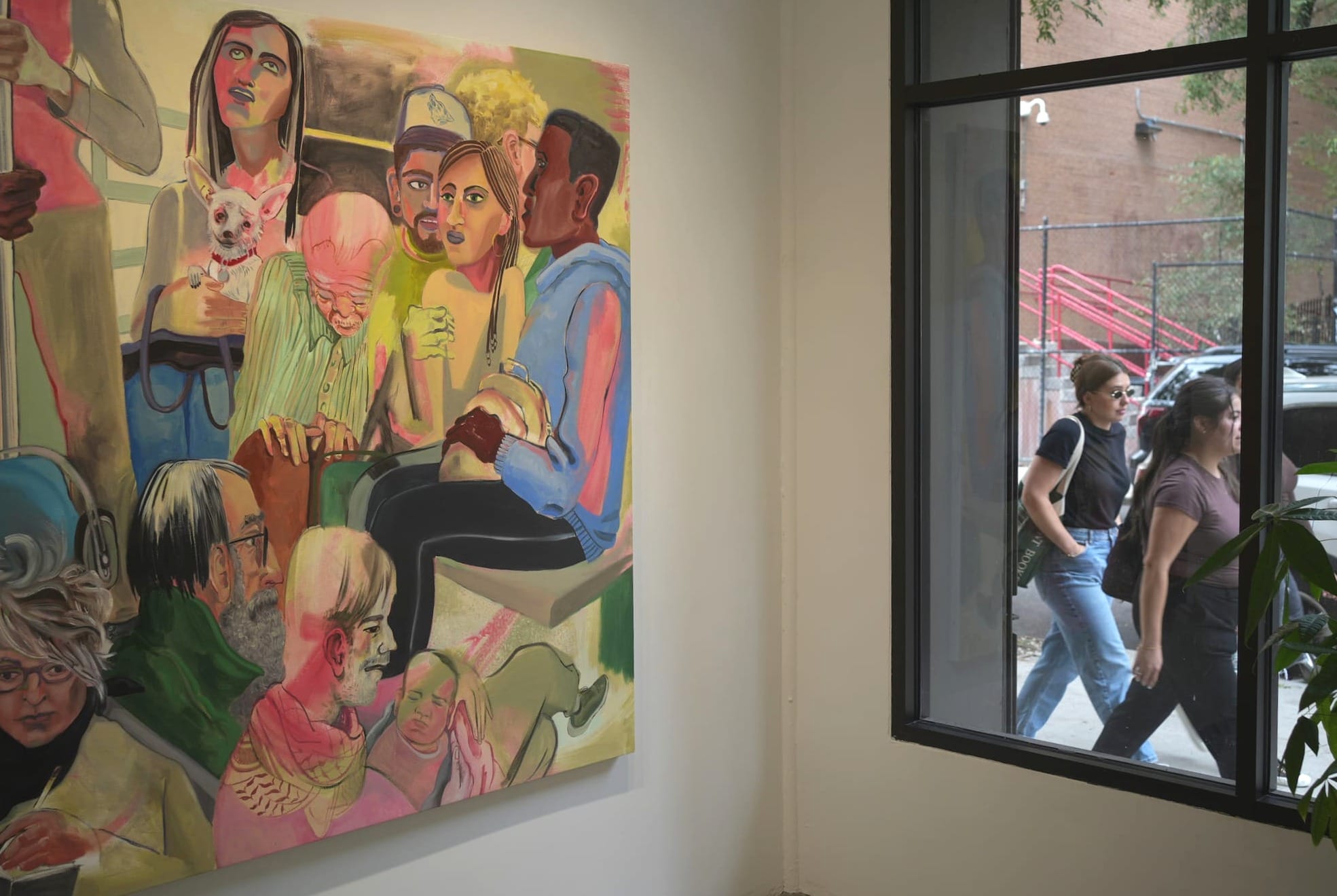
In her artwork, Mala Iqbal captures the bustling atmosphere of urban spaces through vibrant and energetic brushstrokes, often infused with hues of orange and yellow that evoke the glow of artificial light in modern cities. While some pieces, such as "Through the Curtains" (2026), forego this artificial effect, others, like "Through the Curtains," employ a curtain-like tulle render to obscure a scene of collapse, which appears both numb and fragmented.
The painting serves as a metaphor for the rapid, almost overwhelming nature of information conveyed through screens, which we process in a fragmented manner.
Each artwork by Iqbal delves into the construction of reality, with figures and elements arranged in various states of order and chaos. The artist's style, reminiscent of the social realism movement, often carries a mood closer to the gentle strokes of Matisse, evoking a sense of ease and detachment. Her piece "Times Square" (2026) exemplifies this with its chalky palette reminiscent of Ben Shahn, creating a distinct atmosphere without descending into despair.
Many of Iqbal's paintings take place in subway stations, spaces where fleeting encounters give a false sense of intimacy. Despite this, Iqbal never loses sight of the urban masks we wear, as seen in "Subway Riders" (2026), where a figure appears to be recording her own experience, looking outward yet inward. This figure, identified as the artist's partner Angela Dufresne, stares towards the viewer but not at her, a subtle reminder of how our relationships shape and define us just as much as we shape and define them.
One notable detail in her work, "Transparent Friend" (2025), features a recognizable figure, presumably the artist's partner. In this piece, the subject appears to be both recording and observing something of her own experience, gazing towards the viewer but not directly at her. This dynamic invites reflection on how our own relationships mirror and depict us, just as we depict and are depicted by others.
Written by urgent.news from Hyperallergic's reporting — not their text. Machine-written — may contain errors; check the original before relying on it.