James Aboagye: Why film schools must embrace the AI revolution
The film industry is entering one of the most significant technological transitions since the introduction of digital cameras, non-linear editing and computer-generated imagery. Artificial Intelligence (AI) is no longer a futuristic concept waiting to enter filmmaking. It is already becoming part of the filmmaking process.
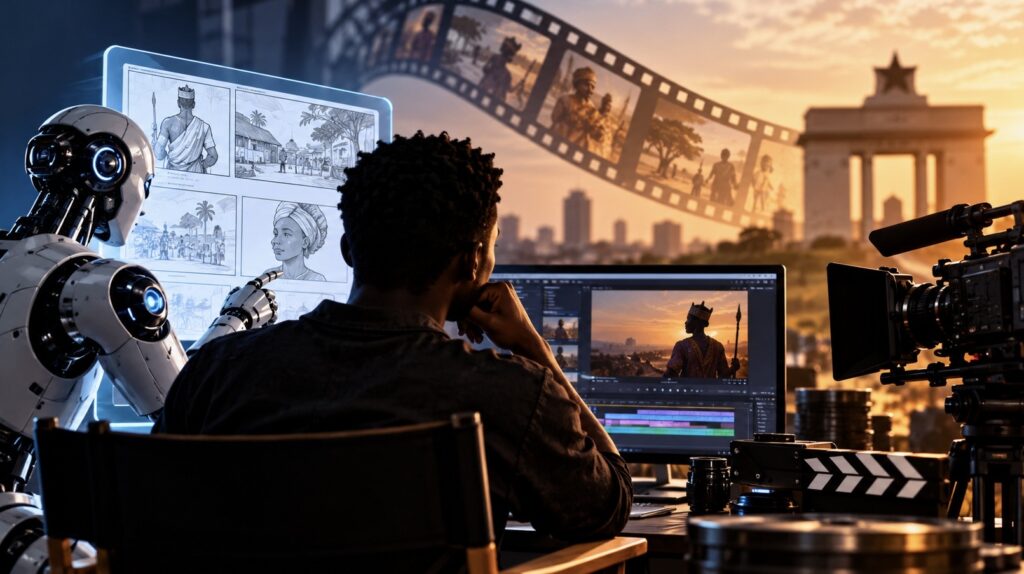
The film industry is undergoing a significant technological transformation, with artificial intelligence (AI) becoming an integral part of the filmmaking process. For Ghana, this development presents both a challenge and an opportunity. Instead of questioning whether AI will impact Ghanaian filmmaking, the more pressing question is how Ghanaian filmmakers can leverage AI to enhance their storytelling or risk falling behind as other industries integrate the technology.
Therefore, film-training institutions in Ghana, including film schools, instructors, trainers, and students, must begin treating AI literacy as a crucial component of contemporary film education. UNESCO has already endorsed this approach, recommending that education systems develop human capacity around generative AI while maintaining human agency, ethics, safety, and equity at the forefront.
Its 2026 guidance for technical and vocational education further asserts that institutions must prepare students for evolving occupational tasks and competencies generated by AI. AI is not the demise of filmmaking; rather, it should be embraced as a potent creative and production tool, not a replacement for human creativity, judgment, experience, and cultural understanding.
Just like cameras, digital editing, and computer-generated imagery, AI should augment, not replace, human capabilities. AI's potential to revolutionize Ghanaian filmmaking is vast and could impact every stage of production.
During the story development and screenwriting stage, AI can assist with brainstorming story concepts, developing characters, exploring alternative story structures, identifying weaknesses in a screenplay, generating scene possibilities, researching historical or cultural contexts, and creating treatment and beat sheets. While AI can aid in these tasks, it cannot replace the filmmaker's unique perspective and cultural understanding.
In pre-production, AI can significantly benefit Ghanaian filmmakers with limited resources by aiding in concept development, generating mood boards, suggesting visual references, designing costumes and locations, planning shots, storyboarding, scheduling, preparing call sheets, developing production breakdowns, and creating budget plans.
For aspiring filmmakers, AI can help them experiment with visual interpretations of scenes before physically filming, fostering a deeper understanding of visual storytelling. However, fundamental cinematography skills such as exposure, lighting, lenses, composition, camera movement, blocking, and visual continuity must still be learned and honed.
During production, AI-assisted systems can streamline information organization and script analysis, improving production management by identifying characters, locations, props, costumes, special requirements, shooting days, and potential logistical issues. This can be particularly advantageous for low-budget productions, allowing producers to save time and money.
In post-production, AI-assisted editing technologies can streamline tasks such as transcription, subtitling, dialogue identification, footage organization, scene detection, noise reduction, audio enhancement, colour correction, visual effects, translation, sound design, and music workflows. For Ghanaian films seeking international audiences, AI can facilitate the creation of multiple language versions, expanding the reach of Ghanaian stories.
Lastly, AI can help reduce the prohibitive cost of producing sophisticated visual effects, enabling independent filmmakers to experiment with complex environments, even within tight budget constraints. However, it is essential to recognize that AI should enhance, not supplant, the essential skills required for filmmaking. The ultimate goal should be to empower filmmakers, not replace them.
Written by urgent.news from MyJoyOnline Ghana's reporting — not their text. Machine-written — may contain errors; check the original before relying on it.