Commentary: Russia’s new jet‑powered drones mark latest evolution in air war above Ukraine
The air war over Ukraine has become more stand-off in nature, say academics.
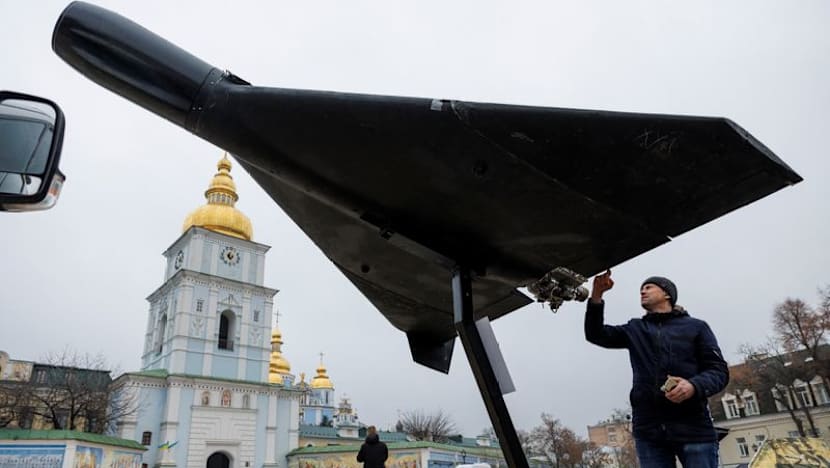
Since the beginning of the Ukraine-Russia conflict, the nature of the air war has transformed. A recent development is Russia's introduction of a new long-range, jet-powered drone called Geran-5. Ukrainian Air Force spokesperson Colonel Yuriy Ihnat revealed that Ukraine only manages to intercept approximately 60% of Geran-5 attacks, compared to the 95% interception rate against other drone models.
The Geran-5's cylindrical body and straight wings give it a profile similar to a cruise missile. It boasts a range of up to 1,000km, a maximum altitude of around 6,000m, and a top speed of about 600km/h. Notably, it also features anti-jamming capabilities, making it challenging for Ukraine's ground-based defenses to intercept.
This new drone's advanced features make it particularly difficult for Ukraine to counter. Russian military expert Yuri Knutov explains that the Geran-5 utilizes machine vision linked to a digital terrain map, enabling it to autonomously identify and select targets. After Russia's full-scale invasion in 2022, both sides relied heavily on combat aircraft for air warfare.
However, the escalating destruction of air defense systems led to a shift towards more stand-off tactics. Long-range tactics, particularly the use of glide bombs launched from afar, became increasingly common. Yet, it was the deployment of drones, which lack crews and can be produced inexpensively in large numbers, that emerged as the dominant force in the air.
Smaller drones operated near the frontlines, while larger, long-range drones targeted deeper areas within Ukraine and Russia.
The earlier long-range drone models, such as the propeller-driven Geran-1 and Geran-2, were relatively easy to shoot down due to their slow speed. Over the years, Russia has deployed versions of the Iranian Shahed-136 drone as its primary long-range drones. In 2025, Russia introduced the jet-powered Geran-3, which was faster than its predecessor, traveling at 330km/h.
The Geran-4, deployed later that year, boasted a higher top speed of 500km/h and a range of 850km. However, it was the Geran-5, introduced in August, that marked a significant leap forward with its even greater speed and longer range. Ukraine's military intelligence has identified components of the Geran-5, revealing its reliance on foreign technologies, including a Chinese jet engine, US-made digital processors, and German transistors.
This demonstrates Russia's ability to bypass Western sanctions and produce these advanced drones domestically.
Written by urgent.news from Channel News Asia's reporting — not their text. Machine-written — may contain errors; check the original before relying on it.
This story
This is one outlet's version. Read the fullest account.