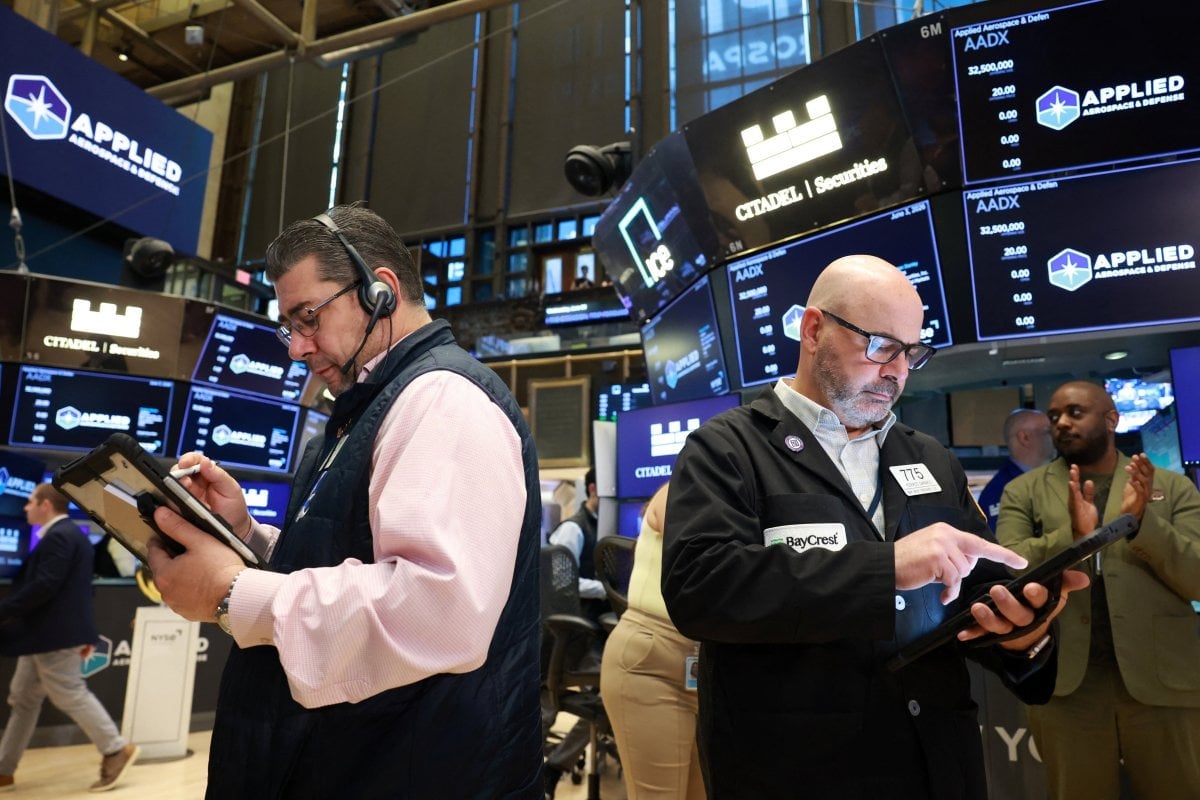
Wall Street dips as surging Treasury yields outweigh software gains
Wall Street’s main indexes slipped on Thursday as a deepening bond selloff drove Treasury yields to multi-decade highs, outweighing gains in software stocks. Although AI enthusiasm continues to power U.S. stocks, soaring Treasury yields are testing investors’ appetite for richly valued shares as inflation and government borrowing keep interest-rate concerns firmly in focus. Global bond markets…
Wall Street's major indexes declined on Thursday as escalating bond sales sparked Treasury yields to record heights, surpassing the strength of software equities. Despite ongoing enthusiasm for artificial intelligence driving U.S. stocks, record-high Treasury yields are challenging investors' enthusiasm for highly valued shares amid inflation and government borrowing concerns.
The benchmark 10-year Treasury note's yield hit 5.3445%, the highest since 2002, following the worst quarter for Treasuries since 1994. Brian Jacobsen, chief economist at Annex Wealth Management, stated that when a safe government bond pays over 5%, equities must justify their price. Third-quarter earnings due in mid-October will provide further insight into company performance.
Downward trends were observed in housing (-1.4%) and banking (-2.2%). Bond-related sectors such as real estate, utilities, and consumer staples also suffered losses. The Cboe Volatility Index (VIX), indicating market fear, climbed to a two-week high of 17.23. Technology remained a positive force, with software shares thriving on Accenture's earnings report, which rose 22% as the company predicted revenue growth above estimates.
Cognizant and IBM also experienced increases of 10% and 4.2%, respectively. The S&P 500 software index rose 1.7% to its highest level since November, outpacing the broader tech index's 0.3% gain. Institutions are reevaluating their software investments, as evidenced by Accenture's response. Micron Technology's revenue forecast and $32 billion customer commitments underpinning supply agreements bolstered confidence in the AI sector, though Micron shares fell about 0.9% after nearly quadrupling this year.
The Dow Jones Industrial Average fell 231.69 points (0.46%) to 50,674.36, the S&P 500 dropped 15.85 points (0.22%) to 7,635.69, and the Nasdaq Composite declined 18.52 points (0.07%) to 26,842.55. Wall Street experienced a challenging September, with both the S&P 500 and Dow posting declines in a traditionally weak month. Lower-than-expected inflation data suggested the Federal Reserve may maintain interest rates steady in October, with a 63% probability of a pause, while a December hike remained possible as inflation remained above the 2% target.
Weekly jobless claims indicated ongoing labor market strength, with applications for unemployment benefits falling and layoffs easing in September. Minneapolis Federal Reserve President Neel Kashkari suggested that while job market conditions were not a key driver of inflation, labor market difficulties would not prevent the central bank from achieving its inflation goal.
Written by urgent.news from Business Recorder's reporting — not their text. Machine-written — may contain errors; check the original before relying on it.
This story
This is one outlet's version. Read the fullest account.
- Gold struggles as rising US Treasury yields outweigh dovish Fed repricing fxstreet.com
- Treasury yields reach multi-decade highs on economic data investing.com
- Dollar holds near two-month high as US Treasury yields rise thepeninsulaqatar.com
- U.S. Treasury yields hit 24-year highs as global bond selloff deepens qz.com
- Strong nominal growth carries a message for Treasury yields. Read more in today’s WSJ Economics newsletter: wsj.com