Measure food systems progress not only by productivity but also ability to deliver healthy diets – AGRA
AGRA West Africa’s acting Regional Director and Senior Program Officer for Inclusive Markets, Trade and Finance, Sunil Dahiya, says food systems progress should be measured not only by their productivity but also by their ability to deliver healthier diets.
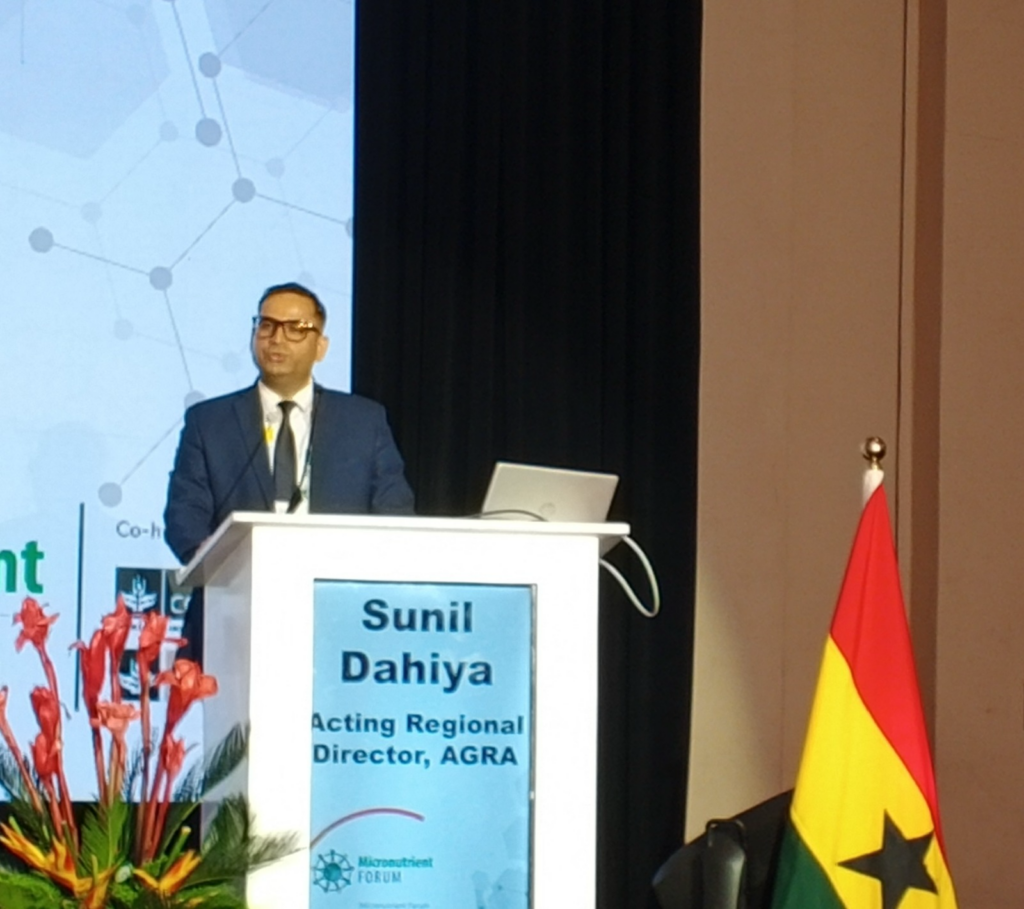
AGRA's senior official emphasizes that measuring food systems success should extend beyond productivity to also consider their capacity to provide healthy diets. At the Micronutrient Forum's 7th Global Conference in Accra, Ghana, Sunil Dahiya, AGRA's acting Regional Director for West Africa, stated, "We at AGRA no longer view nutrition as the endpoint of the food systems story. We consider it a measure of success. If we increase productivity without improving diets, we have not achieved our goal."
Delivering nutritious diets is particularly challenging for African families during adverse weather conditions, like the failed rainy seasons experienced in the Sahel. These families may have sufficient staple crops for calories, but often lack access to nutrient-rich foods such as vegetables, beans, eggs, fish, and milk. Dahiya warned, "Climate change is not just shrinking Africa's harvests; it's emptying our plates of nutrients."
The speaker highlighted that as nutritious foods become scarce and more expensive, households tend to consume more cheap staples, heightening the risk of hidden hunger and micronutrient deficiencies, especially among children. Moreover, climate change has already reduced Africa's agricultural productivity growth by roughly one-third since 1961, according to the Intergovernmental Panel on Climate Change (IPCC).
Dahiya explained, "Our limited irrigation, storage, insurance, and social protection systems, coupled with the fact that Africa accounts for less than 4% of global emissions, make this a matter of both fairness and scientific concern."
Drawing from the recently concluded Africa Food Systems Forum, AGRA's official called for the development of resilient, nutritious seeds, improved trade to distribute nutritious foods across borders, better management of post-harvest losses, and increased funding for nutrition projects. He stressed that climate-adapted and biofortified varieties, such as iron-rich beans and vitamin A maize, need to reach farmers through robust commercial seed systems, not just through pilot projects.
Dahiya argued that when one area fails, open borders could facilitate food transfer from regions with surplus to those facing deficits. In West Africa, every barrier removed from a trade corridor translates into a nutrition measure. He urged stakeholders to invest in micronutrient resilience as much as they invest in climate resilience, ensuring that every African child, woman, and family has the nutrition necessary to thrive, regardless of the weather conditions.
Written by urgent.news from MyJoyOnline Ghana's reporting — not their text. Machine-written — may contain errors; check the original before relying on it.