How long did it take for countries to claim a Nobel laureate?
Deciding where a prize winner is from can be tricky, but Hamish Johnston tries his best The post How long did it take for countries to claim a Nobel laureate? appeared first on Physics World .
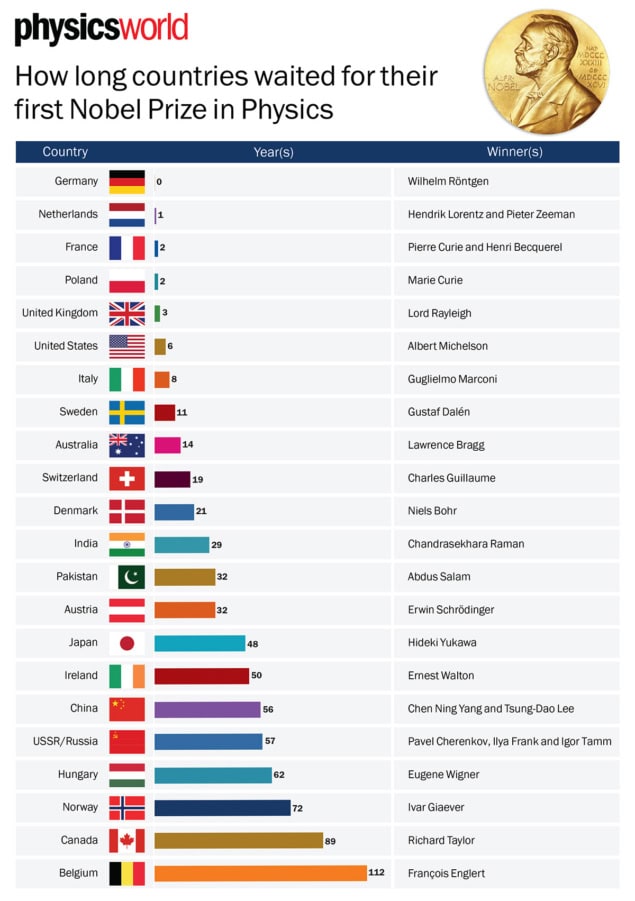
The first country to claim a Nobel Prize in Physics was Germany, with Wilhelm Röntgen receiving the award in 1901 for his discovery of X-rays. Until 1930, most Nobel laureates in physics hailed from Western countries, including Belgium, which won its first physics Nobel most recently in 2013. Currently, only 22 countries have produced Nobel laureates in physics, with India, Pakistan, Japan, the Soviet Union/Russia, and China being the only non-western nations among them. Africa, Latin America, and much of Asia and Oceania have yet to produce a physics Nobel laureate.
To determine the country of origin for a laureate, researchers considered the person's birthplace and the country's current status. For example, Ernest Walton, considered the first Irish laureate, was born in a part of the UK but spent most of his life in Ireland, and his research was conducted in England. While Marie Curie was born in what was then part of the Russian Empire, she was clearly proud of her Polish heritage, having named the element polonium after her homeland.
The infographic took into account historical events such as decolonization, as well as the fact that some laureates, like Chen Ning Yang and Tsung-Dao Lee, conducted their prize-winning work outside their home countries. Despite the long wait for Pakistan, the country's first Nobel laureate, Abdus Salam, received the award in 1979, just 32 years after the country gained independence in 1947.
Written by urgent.news from Physics World's reporting — not their text. Machine-written — may contain errors; check the original before relying on it.