Flare Launches Confidential Compute With Private Proof of Reserves for Hex Trust's USDX
Flare launches Confidential Compute on Songbird so smart contracts can verify private institutional data, starting with Proof of Reserves for Hex Trust's USDX.
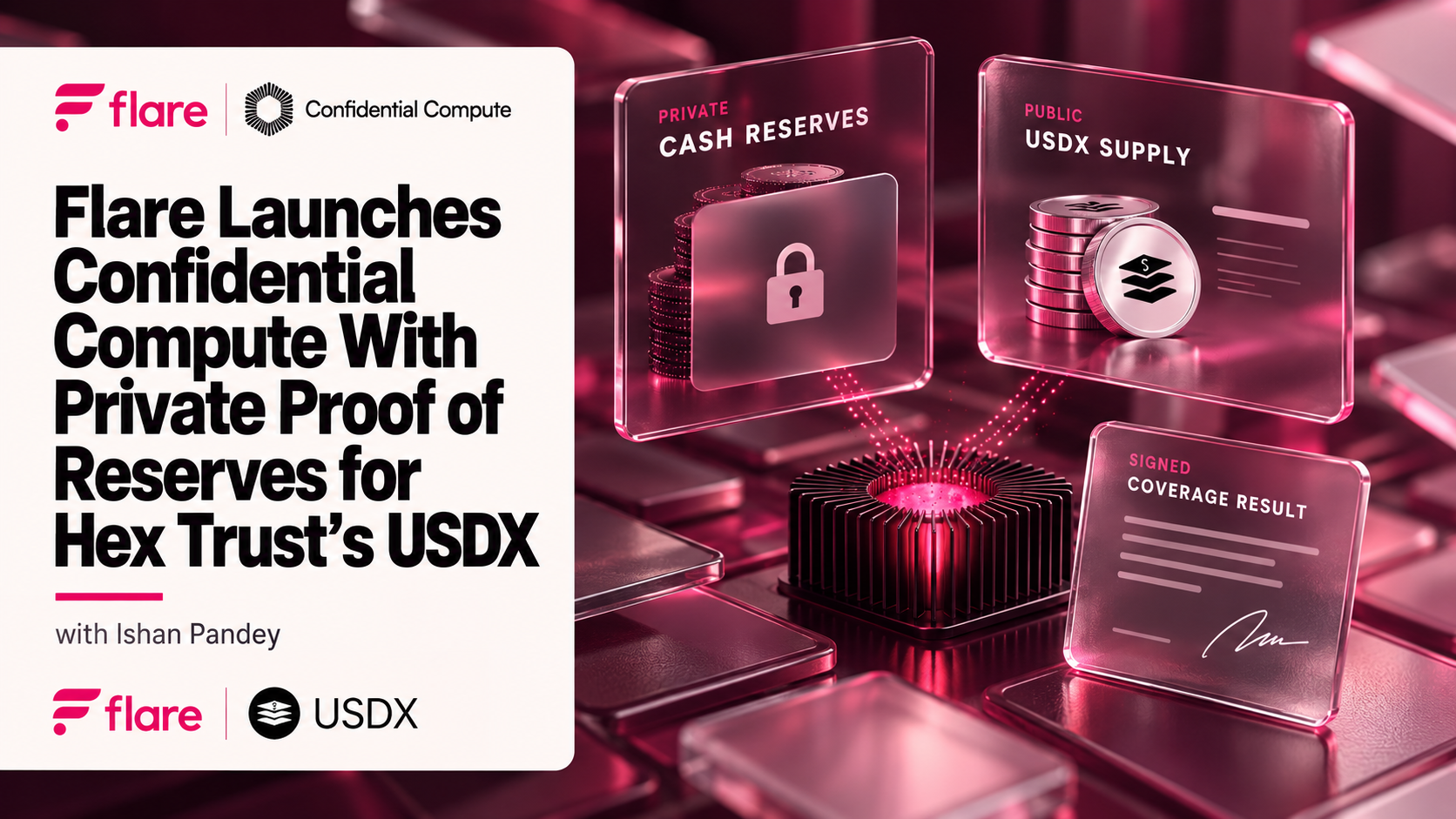
The USDX stablecoin, issued by Hex Trust, has launched a new feature called Flare Confidential Compute, which enables private proof of reserves for its token. This is made possible through Flare Confidential Compute, a blockchain technology that processes private data within a secure Trusted Execution Environment (TEE) and returns a signed result that smart contracts can verify without exposing the underlying data.
The first application of this technology is the Proof of Reserves extension for USDX, giving a market of over $300 billion a way to demonstrate token backing without publishing the issuers' balance sheet. Flare provides smart contracts with public data through two protocols, the Flare Time Series Oracle for market prices and the Flare Data Connector for verified facts from other blockchains and Web2 systems.
The data is processed inside a TEE, which is a hardware-isolated enclave, and the signed result is returned for verification by the contracts. The technology is currently being tested on Flare's canary network, Songbird, and a full deployment on the mainnet is planned separately. The rise of stablecoins has been dramatic, with supply growing from about $27 billion at the end of 2020 to a record $322.4 billion in May 2026, an 11.9-fold increase over six years.
This growth has drawn regulatory attention, as stablecoin issuers are now required to hold one-for-one reserves in assets such as cash, insured deposits, and short-dated US Treasury bills, with monthly reserve reports that are examined and certified by registered accounting firms.
Written by urgent.news from HackerNoon's reporting — not their text. Machine-written — may contain errors; check the original before relying on it.