SpaceX's Giant Starship Rocket Reached Earth Orbit on Its First Try, but Engine Problems Forced It to Return to the Planet Early
Two aerospace companies are competing to create the lunar lander NASA uses when it returns humans to the moon's surface. But to reach our lunar companion, a spacecraft will first have to get to Earth orbit
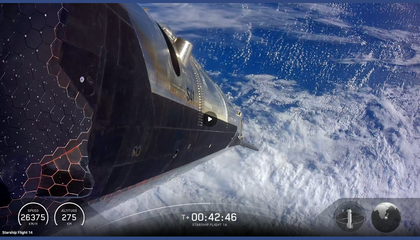
SpaceX's Starship reached Earth orbit for the first time on September 28, a significant milestone for the company after 13 previous test flights remained suborbital. The 14th flight launched from SpaceX's Starbase facility in southern Texas, with the upper stage, Ship 41, carrying 26 Starlink V3 satellites into orbit. This marked the first operational payload for Starship.
However, the mission faced an engine fault when one of the six Raptor engines shut down early during the climb. Though engineers confirmed they could complete the flight, SpaceX cut the mission to about three hours due to the issue.
Despite the shortened duration, Starship successfully reached orbit, deployed all 26 satellites, and completed a controlled return to Earth. The newly released satellites are expected to add roughly a terabit per second of capacity to the Starlink constellation. After the satellite deployment, the single remaining Raptor engine fired for about 19 seconds, pushing Starship to an altitude of roughly 275 kilometers before a deorbit burn slowed the spacecraft and it splashed down in the Pacific Ocean north of Hawaii.
As expected, the vehicle tipped onto its side and exploded after contact with the water, consistent with SpaceX's current recovery capabilities.
This successful orbital flight demonstrates Starship's ability to reach orbit, but it did not complete all mission objectives. The engine fault's impact extends beyond SpaceX, as NASA plans to utilize a version of Starship with the same Raptor engine system to land astronauts on the Moon in NASA's Artemis program. The engine shutdown could influence the recovery process and potentially affect future flight schedules, which are critical for NASA's Artemis III mission, planned for 2027.
NASA aims to return astronauts to the Moon by 2028, ahead of China's 2030 target. The mission's success positions Starship competitively against other lunar landers, including Blue Origin's Blue Moon, with SpaceX potentially retiring its Falcon rockets and Dragon capsules as Starship matures.
Written by urgent.news from Colombia One's reporting — not their text. Machine-written — may contain errors; check the original before relying on it.
This story
This is one outlet's version. Read the fullest account.