Saturn’s moon offers clues in search for alien life
Saturn's moon may aid in the search for alien life by making some ocean compounds easier for future spacecraft to detect.
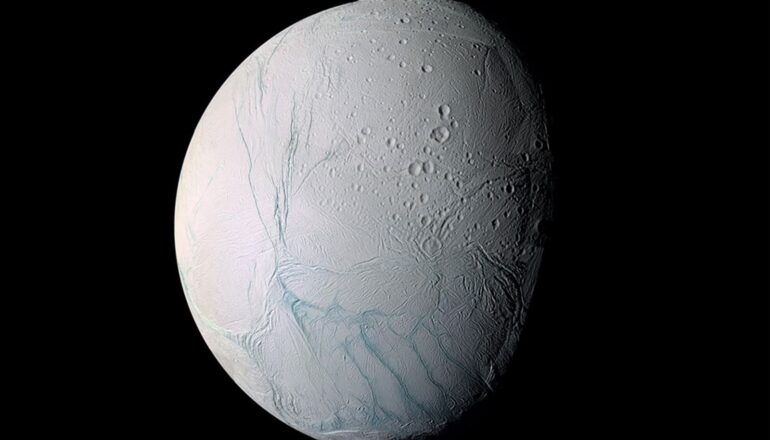
Saturn's moon Enceladus, which harbors a global ocean beneath its icy surface, could significantly contribute to the ongoing search for extraterrestrial life, according to a new study. The research, published in Science Advances, reveals that salts and organic compounds in Enceladus's ocean are naturally concentrated in individual grains during the formation of jets that erupt from the moon's south pole.
These grains, containing both salts and organic molecules, could be much more easily detected by future spacecraft. The study, conducted by researchers at the University of California, Riverside and Freie Universität Berlin, utilized data from NASA's Cassini spacecraft, which collected samples from Enceladus's plume over the course of its mission.
The researchers analyzed nearly 1,000 individual salt-rich ice grains and discovered that the concentration and separation of salts occurs before the droplets freeze and break apart. By combining Cassini data with laboratory experiments and models, the scientists demonstrated that the process of freezing and fragmentation creates distinct regions of different salt concentrations within a single grain.
This natural separation and concentration of compounds could aid in identifying biomarkers or other signs of life in future samples from Enceladus. The findings suggest that future missions should prioritize analyzing individual grains rather than averaging the compositions to maximize the chances of detecting rare and potentially biosignature-rich particles.
Written by urgent.news from Futurity's reporting — not their text. Machine-written — may contain errors; check the original before relying on it.