Philippine eagle habitat study maps mining risks and conservation priorities
A new study mapping the likely nesting habitats of the iconic Philippine eagle in its main stronghold warns that the threat of habitat loss — a key driver of its disappearance across much of its range — still looms large for the critically endangered species. The study, published in Bird Conservation International, shows that approved […]
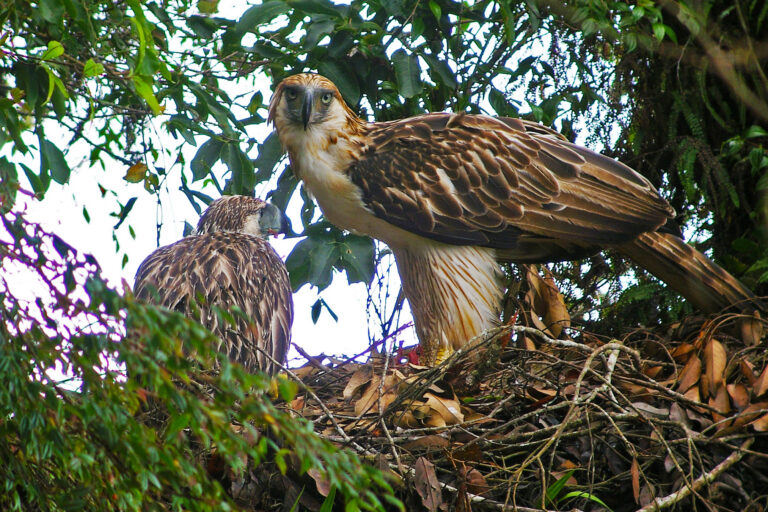
A recent study identifying the potential nesting habitats of the Philippine eagle in its primary area of habitation has highlighted the alarming risk of habitat loss as a critical factor contributing to the decline of this critically endangered species. The research, published in Bird Conservation International, reveals that approved mining concessions cover 41% of the highly suitable nesting sites and 65% of the core areas in eastern Mindanao, the southernmost and second-largest island of the Philippines.
It is worth noting that only about 35% of the highly suitable habitat identified across the Eastern Mindanao Biodiversity Corridor is protected.
The study, co-authored by Christopher J.W. McClure, the vice president for global science at the U.S.-based NGO The Peregrine Fund, indicates that merely 35% of the highly suitable habitat for the Philippine eagle is presently protected. Indigenous ancestral domains, meanwhile, overlap with 65% of the core high-quality nesting habitat. As indicated by the study, the data do not represent the same areas.
Ornithologist and curator of birds at the Museum of Natural History at the University of the Philippines Los Baños, Juan Carlos Gonzalez, who was not involved in the research, expressed concern over the findings. He emphasized the limited available habitat within protected areas and the continued existence of Philippine eagles in Indigenous-managed forests, both of which represent the last stronghold for the species.
Written by urgent.news from Mongabay's reporting — not their text. Machine-written — may contain errors; check the original before relying on it.