In Brazil’s capital, residents grow their own heat-fighting solutions
Life in the favelas surrounding Brazil’s capital brings the health risks of extreme heat — a symptom of the global inequities of green space access
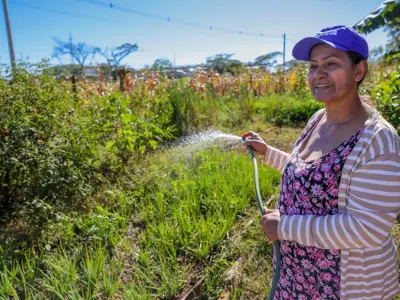
In Brazil's capital, Brasília, residents are taking matters into their own hands to combat rising temperatures. The city, designed with green spaces in mind, now faces a stark contrast between its affluent central area and poorer peripheral neighborhoods. In Ceilândia, Nasaré Francisca da Silva, for example, has transformed a rubbish tip into an agroforestry project, planting crops and trees to provide cooling relief.
Studies show that Brasília's central area, the Plano Piloto, boasts about 138 sq meters (1,485 sq feet) of green space per person, while peripheral areas have as little as 6 sq meters (64 sq feet). This green space disparity is mirrored across many Brazilian cities, with the Global South experiencing twice the inequality found in Northern cities. Heat waves disproportionately affect low-income neighborhoods, leading to severe health issues.
To adapt, some residents are adopting guerrilla gardening techniques, planting trees and grass in areas where urban planning has failed. The local government is also planning a tree planting program, but experts argue that green space distribution must be more equitable. The "3-30-300" rule suggests that every person should be within 300 meters of a park and have at least 30% tree coverage in their neighborhood to access nature's cooling benefits.
Brazil's National Urban Tree Planting Plan aims to address this issue, with the goal of increasing tree access for 40 million more residents by 2045.
Written by urgent.news from Global Voices Brazil's reporting — not their text. Machine-written — may contain errors; check the original before relying on it.