Fresh grads may earn more, but S’pore has fewer entry-level jobs in 2026: Report
Singapore’s starting salaries may be on the rise, but the number of entry-level roles is shrinking, reported global professional services firm Aon in its latest 2026 Salary Increase and Turnover Study. The report, released on Sept 23, surveyed over 1,200 organisations in more than 20 industries across Indonesia, Malaysia, the Philippines, Singapore, Thailand and Vietnam. […]
Aon's 2026 Salary Increase and Turnover Study reveals that starting salaries in Singapore may be increasing, but entry-level job opportunities are decreasing. The study surveyed over 1,200 organizations across 20 industries in seven Southeast Asian countries. Entry-level employees in Singapore experienced a 2.5% year-on-year salary increase, while the number of entry-level roles dropped by 3.2% from 2025. This trend is contributing to an increasingly competitive job market for recent graduates.
A joint survey conducted by Singapore's six autonomous universities found that 83.4% of recent graduates secured jobs within six months of their final exams, down from 87.1% in 2024. This downward trend has been ongoing since 2022. Aon's report also indicates a shift in employer expectations for new hires, as AI becomes more prominent in the workplace.
According to Rahul Chawla, a partner and Head of Talent Solutions for Southeast Asia at Aon, companies should redesign graduate roles with a focus on problem-solving, judgment, human skills, and the ability to work effectively with AI. This approach aims to mitigate the risk of creating a future capability gap.
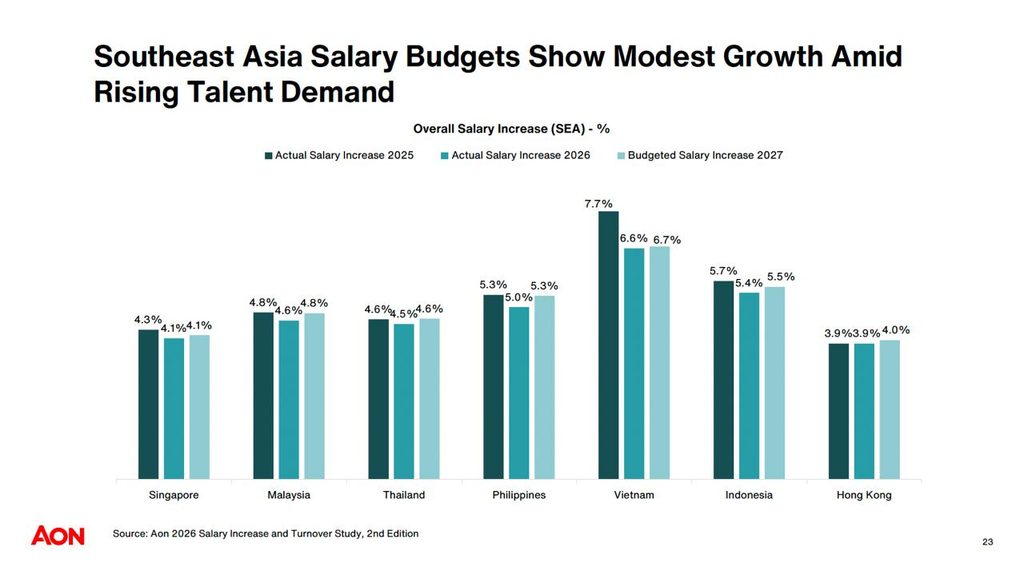
While Singapore saw the slowest growth in wages among Southeast Asian countries, with an increase of 4.1% in 2026, Vietnam led the region with a 6.6% salary rise, followed by Indonesia at 5.4%. In Singapore, the Retail & Hospitality sector experienced the highest salary increase at 4.5%, while Life Sciences & Medical Devices and Technology sectors grew by 4.3% and 4.2%, respectively.
Financial services had the highest involuntary turnover rate at 8.1%, followed by Technology at 5.7% and Consulting, Business & Community Services at 4.9%.
As AI continues to reshape the job market, several banks, including DBS and Standard Chartered, have announced job cuts. Aon's study revealed that leadership and people management skills were the most in-demand, chosen by 49% of organizations, while data and analytical skills, as well as AI and automation skills, were equally sought after at 48% each. Companies that invest in continuous and targeted upskilling are positioning themselves for success in the face of evolving job requirements.
Written by urgent.news from Vulcan Post's reporting — not their text. Machine-written — may contain errors; check the original before relying on it.