Forecasting space weather risks on power grids
Extreme space-weather events can damage power systems on Earth and degrade GPS accuracy and satellite operations. A new machine learning system can predict where damage is likely to occur 30-60 minutes before a storm arrives. The post Forecasting space weather risks on power grids appeared first on Microsoft Research .
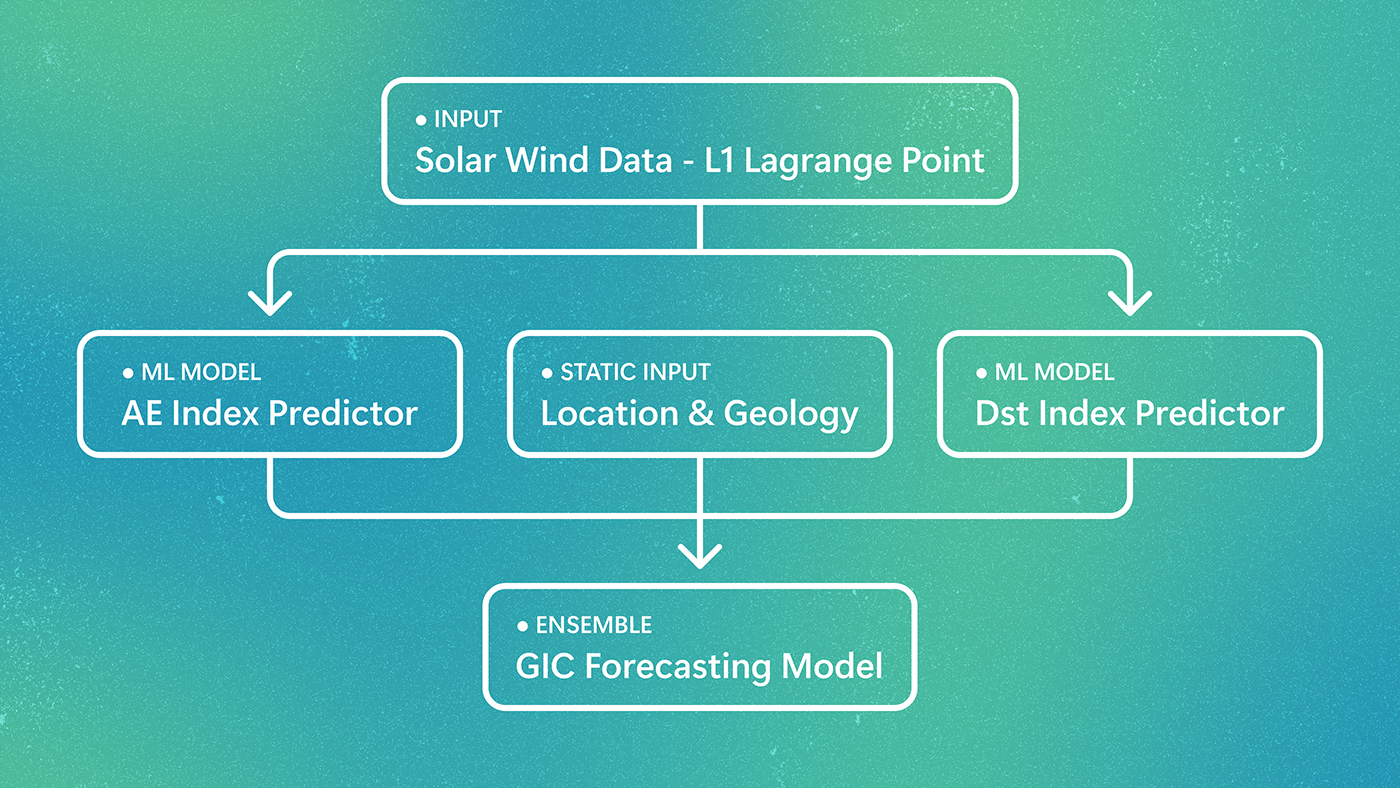
A machine learning pipeline has been developed to forecast space weather risks on power grids across the continental United States. This system combines solar-wind forecasts with local factors such as latitude, geology, and ground conductivity to estimate risk for 66,935 substations. During testing, the pipeline detected nearly 80% of major space weather events and provided 30-60 minutes of warning before specific risks occurred.
The challenge lies in predicting when and where a storm's effects could be most severe, as extreme space weather can damage power equipment and increase operational risk. The pipeline employs three stages: first, it generates forecasts of the Auroral Electrojet and Disturbance Storm Time indices using solar-wind measurements; second, it employs a gradient-boosting model to estimate the rate of magnetic-field change associated with GIC risk; and finally, it converts these predictions into location-specific risk estimates and aggregates them into a continental risk assessment.
The system was evaluated using public data sources like NASA's OMNI and Kyoto World Data Center data, INTERMAGNET observations, and GridSFM-derived grid data. The AE predictor outperformed existing empirical solar-wind-based approaches in forecasting rare, high-intensity geomagnetic activity that drives infrastructure risk. The Dst predictor provided an additional signal for large-scale geomagnetic storm strength.
The GIC risk stage, which calculates the rate of magnetic-field change (GIC), was compared to simple linear regression and achieved detection rates of 76.5% for major events, 81.2% for severe events, and 64.1% for extreme events.
Written by urgent.news from Microsoft Research's reporting — not their text. Machine-written — may contain errors; check the original before relying on it.