Finding Life on Enceladus Could be Easier than We Thought, Says New Research
Planetary scientists from Freie Universität Berlin have published two new studies that indicate that a spacecraft could identify evidence of life much more easily than previously thought.
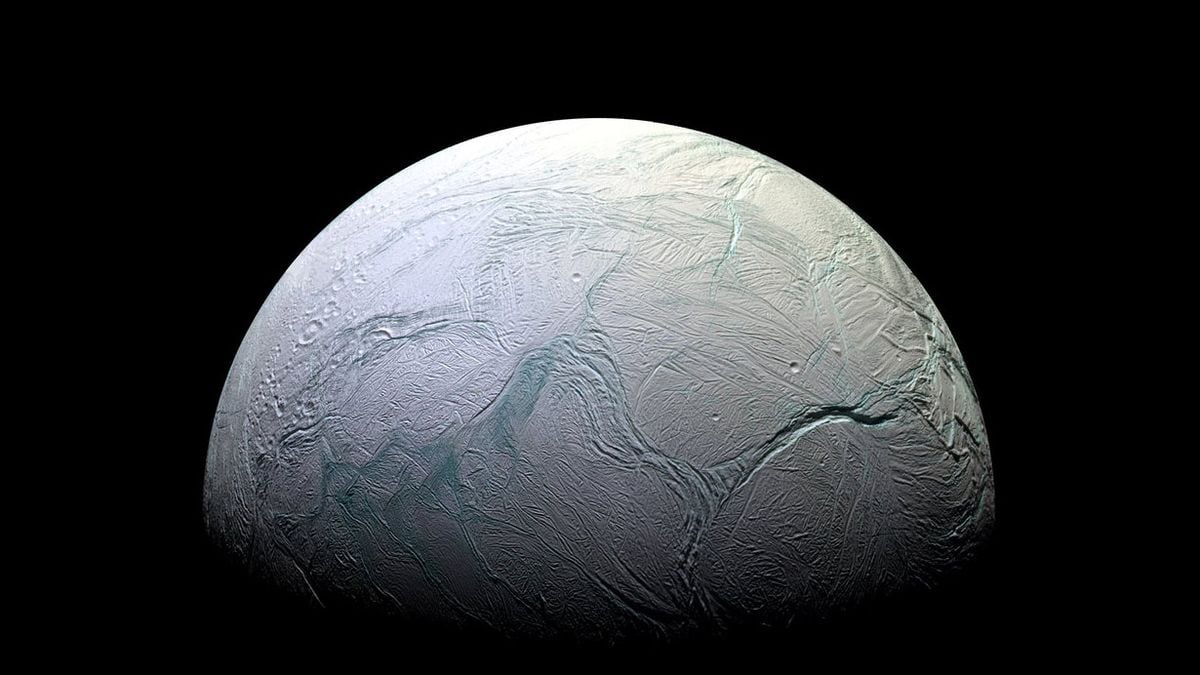
Enceladus, a moon of Saturn, is currently one of the most promising locations for the search of extraterrestrial life due to its subsurface ocean. This ocean exists between its icy surface and a rocky, metallic core, and is kept warm by tidal heating, which drives the movement of water. The Cassini spacecraft has already identified salts and organic compounds in the plumes of ice particles that erupt from Enceladus' south polar region, providing evidence to suggest that this ocean could support life.
Researchers from Freie Universität Berlin have recently published two studies that further bolster the idea that an Enceladus exploration mission might have an easier time detecting biosignatures than previously believed. The first study reveals that ocean droplets can freeze more slowly than previously thought as they travel through cracks in the moon's ice shell.
As the droplets freeze and release their contents, salts and organic compounds are dispersed into various areas, which can then break up when accelerated into space, producing ice grains that may contain highly concentrated substances.
The second study shows that methane-producing bacteria (methanogens) could survive and generate methane in the simulated conditions present on Enceladus. This finding suggests that a probe passing through the moon's plumes could potentially detect biomarkers resulting from life and biological processes in the interior. These findings will play a crucial role in guiding several missions currently under development, such as the NASA Flagship mission Enceladus Orbilander and the European Space Agency's L4 Enceladus Mission.
Both missions aim to sample the water plumes and analyze materials for evidence of life. Additionally, a privately funded mission called Breakthrough Enceladus is also in the works. These missions emphasize the significance of Enceladus as a potential future destination for astrobiology exploration.
Written by urgent.news from Universe Today's reporting — not their text. Machine-written — may contain errors; check the original before relying on it.