Designing Peptide Screens to Generate Knowledge, Not Just Hits
The strongest binder from a primary screen is not necessarily the best drug starting point. Peptide discovery campaigns should capture molecular architecture, biological context, time, and developability from the outset. The post Designing Peptide Screens to Generate Knowledge, Not Just Hits appeared first on GEN - Genetic Engineering and Biotechnology News .
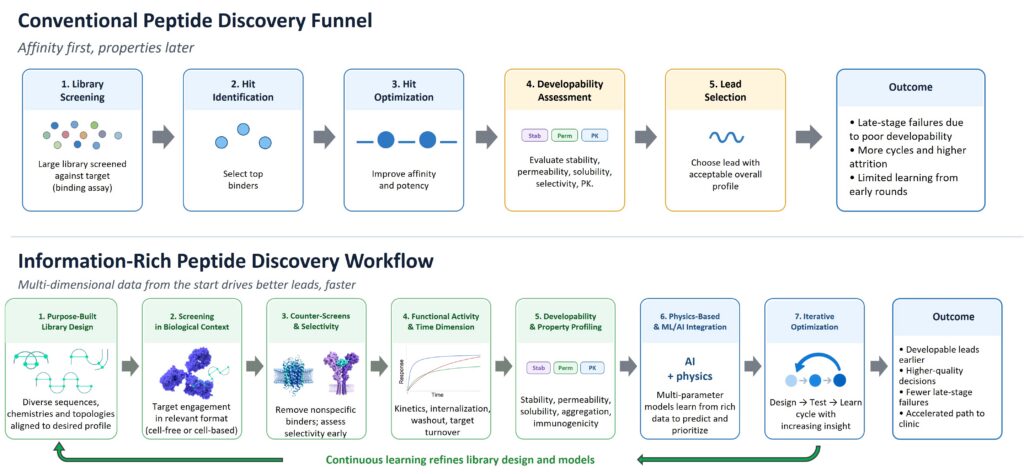
Peptide discovery is undergoing a shift towards a more holistic approach, focusing on generating knowledge rather than merely amassing high-affinity hits. Researchers are developing larger libraries, incorporating unconventional residues, and utilizing advanced computational tools to optimize candidate selection. However, the traditional emphasis on identifying the strongest binder often overlooks crucial factors such as selectivity, solubility, synthetic tractability, stability, and cellular accessibility.
A screen that only reports binding data leaves important considerations for later stages of development. The next breakthrough will not stem from choosing between experimental screening and computational methods, but rather from designing experiments that provide a more nuanced understanding of the chemical and biological landscape.
The library itself is not unbiased; its characteristics, including length distribution, residue alphabet, cyclization chemistry, topology, display format, and synthesis method, influence the molecules that can be produced and the conformations they can adopt. Peptide function is not solely determined by sequence; variations in conformation, stereochemistry, and backbone modifications can lead to different behaviors.
Recent research demonstrates the potential of treating binding and permeability as interconnected design challenges, rather than separate stages. A recent study screened 15,360 cyclic peptides and identified a starting point against the intracellular Keap1–Nrf2 protein-protein interaction. Through iterative design, synthesis, and testing, a membrane-permeable inhibitor was successfully produced and demonstrated activity in living cells.
The key takeaway is that binding and permeability should be addressed concurrently during the design process, rather than treated as sequential hurdles. The traditional funnel approach, which progresses from a broad pool of compounds to a refined lead, should be replaced with an information-rich workflow that incorporates architecture diversity, counterselections, functional assays, and property measurements before lead selection.
While purified-protein screens remain valuable, especially under resource constraints, they can inadvertently favor peptides that recognize purification tags or exposed hydrophobic patches. To mitigate this, early counterselection steps can remove binders to tags, matrices, related proteins, or off-targets, and competition experiments can assess dependence on the intended epitope.
Orthogonal confirmation methods, such as kinetic binding, solution-phase competition, biochemical function, or cell-based activity, can help distinguish genuine target engagement from assay-specific behavior. For intracellular targets, permeability and functional activity should be considered from the outset, while for extracellular targets, factors like serum stability, target turnover, tissue context, and the impact of sustained versus transient engagement become more significant.
Screening readouts are snapshots of biological systems, which are inherently dynamic. A peptide with adequate equilibrium affinity but a slow dissociation rate may exhibit stronger functional activity than a tighter binder with a rapid dissociation. Conversely, prolonged engagement may be undesirable if it leads to off-target interactions that pose risks.
Time can be accounted for by adjusting wash periods, introducing soluble competitors, and testing candidates under various physiological conditions. Cellular assays can separate immediate pathway modulation from long-term activity that persists after washout. Internalization and cytosolic access can be quantified at multiple time points, providing a more comprehensive picture of the molecule's behavior.
Round-by-round enrichment can also capture temporal information, helping to identify credible candidates with steady increases in enrichment rather than abrupt rises after bottlenecks. The final hit list often fails to capture the full range of information from the screening dataset. "Inactive" candidates should not be lumped together as a single category; rather, each failure should be carefully analyzed to determine the specific reasons for its lack of success.
A peptide may be deemed inactive due to inefficient production, improper display, incorrect modification, aggregation, degradation, nonspecific binding, cell entry barriers, or lack of functional change. These distinct outcomes should not be conflated into a single negative label. Instead, a model trained on this diverse data can learn valuable insights about the complex interplay of factors that contribute to a peptide's efficacy.
Written by urgent.news from GEN Biotechnology's reporting — not their text. Machine-written — may contain errors; check the original before relying on it.