All of a flutter: how butterflies avoid being a predator’s lunch
Their whirring wings and bright patterns help keep them safe from birds, British study finds Naturalists have long wondered how brightly coloured butterflies manage to evade the attention of birds that make a meal of other insects. New research from British ecologists suggests it is not simply a matter of good luck but instead a visual illusion created by their fluttering wings. Continue…
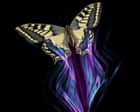
British researchers have discovered how brightly colored butterflies evade detection by birds that dine on other insects. A study from universities in Exeter and Essex reveals the insects' fluttering wings and distinctive patterns create visual illusions that confuse predators' perception of the butterflies' speed and direction.
Dr. George Hancock of Exeter's Centre for Ecology and Conservation explained that the wing movements and patterns counteract the predator's most basic visual targeting system, often causing them to miss their target entirely. Dr. Jolyon Troscianko added that the shifting angles of the stripes and the unpredictable flight paths of butterflies contribute to the illusions, making it difficult for predators to accurately judge where to strike, causing them to miss or target less vulnerable parts of the insect.
The researchers compared this phenomenon to the "barber pole illusion," where striped patterns seem to move in an unnatural direction despite the object only spinning in place. The breakthrough came when Troscianko used slow-motion video analysis to demonstrate that a butterfly flying upward appeared to move downward in a bird-vision computer model.
The team found that different patterns created varying effects, with swallowtail butterflies being particularly adept at this visual trickery. Swallowtails' hindwings often have tails and beak-shaped holes indicative of past bird attacks, supporting the team's conclusions about motion confusion. The study also found that white butterflies appear to move faster than they actually do due to their contrasting coloration against the sky, providing an additional layer to their defense mechanism.
The findings, published in the journal Nature, suggest that motion confusion might be more prevalent among animals than previously thought, potentially extending to other species such as birds and fish.
Written by urgent.news from Guardian Science's reporting — not their text. Machine-written — may contain errors; check the original before relying on it.