The un-ordered UN order
With the UN about to choose a new secretary-general and United States President Donald Trump’s administration openly hostile to multilateralism, it is unclear how much longer the system can stagger on.
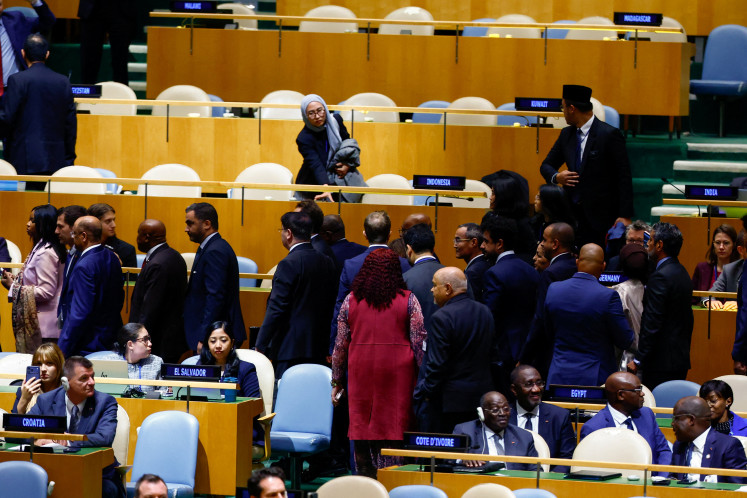
As world leaders gather in New York City for the 81st session of the United Nations General Assembly, the international order they sought to defend is in a state of turmoil. The United States' administration, under President Donald Trump, is openly hostile towards multilateralism, casting doubt on the system's longevity. With the UN set to choose a new secretary-general, concerns arise about its ability to maintain order.
China and Russia, who never fully embraced the post-Cold War system, along with newly assertive middle powers, resent the current order. The American public, too, has lost interest in funding the UN. This is not an interregnum, but rather a new era of disorder, or "un-order," where states act without reference to a common framework.
Instances of disorder are evident, such as the US-Israel war against Iran, where it's unclear if a ceasefire existed or who emerged victorious. Disputes often cross domains, like Trump's pressure on Greenland leading to threats of tariffs against the European Union. The reliance on maritime chokepoints for global trade is now a weapon, as seen in the closure of the Strait of Hormuz and Bab al-Mandeb.
In response, some act like architects, defending universal norms and preserving existing institutions, while others improvise and adapt quickly to the changing landscape. China, for instance, has strengthened its Shanghai Cooperation Organization and BRICS, joined the Arctic Council as an observer, and integrated surveillance-friendly internet standards.
Europeans can learn from this approach, using infrastructure instead of treaties to forge connections. Despite the chaos, multilateralism isn't dying; it's evolving. Middle powers are creating innovative cooperation, such as Barbados' Bridgetown Initiative and the India-Middle East-Europe Economic Corridor. These efforts, while improvised, mirror the UN's original purpose.
Europeans face an uncomfortable moment, needing to catch up with the changing times, but with the right strategy, they stand to gain significantly. Canadian Prime Minister Mark Carney has sought an "alliance for the future" in Strasbourg, recognizing the EU's potential as an anchor for the West.
Written by urgent.news from The Jakarta Post's reporting — not their text. Machine-written — may contain errors; check the original before relying on it.